


[See Part 1, Part 2, and Part 3]
In July 2009, two weeks after the Supreme Court rendered its decision in Ricci v. DeStefano, the case was front and center at Sonia Sotomayor’s confirmation hearing. Senator Patrick Leahy, the Democratic chairman of the Judiciary Committee, badly mischaracterized Sotomayor’s role in the case, and Sotomayor embraced his mischaracterizations.
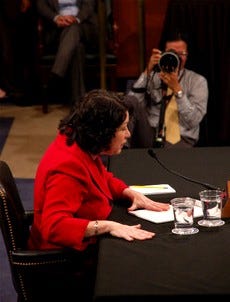
***
In his opening statement, Senator Jeff Sessions, the senior Republican on the Judiciary Committee, charged that Sotomayor’s shoddy handling of the Second Circuit appeal in Ricci illustrated the unsoundness of Barack Obama’s “empathy” standard for selecting justices and of Sotomayor’s own celebration of the “wise Latina” judge who draws on the “richness of her experiences”:
Judge Sotomayor has said that she accepts that her opinions, sympathies, and prejudices will affect her rulings. Could it be that her time as a leader in the Puerto Rican Legal Defense and Education Fund, a fine organization, provides a clue to her decision against the firefighters?
While the nominee was Chair of that Fund’s Litigation Committee, the organization aggressively pursued racial quotas in city hiring and, in numerous cases, fought to overturn the results of promotion exams. It seems to me that in Ricci, Judge Sotomayor’s empathy for one group of firefighters turned out to be prejudice against another.
That is, of course, the logical flaw in the ‘‘empathy standard.’’ Empathy for one party is always prejudice against another.
***
Senator Patrick Leahy, the Democratic chairman of the Judiciary Committee, used his first round of questioning to attempt to preempt any further attack on Sotomayor over Ricci. Leahy appears to have been unburdened in this endeavor by any scruples about getting things right. Here’s what he asserted:
Now, the legal issue that was presented to you in that case was not a new one—not in your circuit. In fact, there was a unanimous, decades-old Supreme Court decision as well. In addition, in 1991, Congress acted to reinforce that understanding of the law…. So you had a binding precedent. You and two other judges came to a unanimous decision. Your decision deferred to the district court’s ruling allowing the city’s voluntary determination that it could not justify using that paper-and-pencil test under our civil rights laws, you say it was settled judicial precedent. A majority of the Second Circuit later voted not to revisit the panel’s unanimous decision; therefore, they upheld your decision.
So you had Supreme Court precedent. You had your circuit precedent. You were upheld within the circuit. Subsequently, it went to the Supreme Court, and five, a bare majority of five Justices reversed the decision, reversed their precedent, and many have said that they created a new interpretation of the law.
Leahy’s contention that “binding precedent” dictated the Second Circuit panel’s decision in Ricci is flatly wrong. Sotomayor and her panel colleagues didn’t make that claim in their opinion, and the district-court ruling that they essentially adopted went no further than to claim (sloppily) that a previous circuit case holding was “quite relevant and instructive.” As Judge José Cabranes wrote in his dissent from the denial of rehearing en banc:
This appeal raises important questions of first impression in our Circuit — and indeed, in the nation — regarding the application of the Fourteenth Amendment's Equal Protection Clause and Title VII's prohibition on discriminatory employment practices.
Leahy either didn’t understand what the “legal issue” in Ricci was or didn’t want anyone watching the hearing to understand. The “unanimous, decades-old Supreme Court decision” he was referring to is Griggs v. Duke Power Co. (1971), which ruled (as I explained more fully in my Part 3 post) that Title VII plaintiffs may pursue claims of “disparate impact.” Leahy was correct that the 1991 amendments to Title VII “reinforce[d] that understanding of the law.” But no one disputed that in Ricci. The legal issue instead was whether and when (as Justice Kennedy put it in his majority opinion in Ricci) “an employer can engage in intentional discrimination for the asserted purpose of avoiding or remedying an unintentional disparate impact.” The Supreme Court had never decided that issue before, and neither had the Second Circuit. So Leahy’s claim that Sotomayor was just following “binding precedent” is poppycock.
It is appalling to see that Sotomayor, in responding to Leahy, embraced his mischaracterization of precedent:
You are correct, Senator, that the panel, made up of myself and two other judges, in the Second Circuit decided that case on the basis of a very thorough, 78-page decision by the district court and on the basis of established precedent.
The issue was not what we would do or not do, because we were following precedent, and you—we’re now on the circuit court—are obligated on a panel to follow established circuit precedent.
You might charitably think that Sotomayor was contending only that the panel decision was consistent with circuit precedent—i.e., was a defensible extension of that precedent. But she immediately extinguished any integrity-salvaging ambiguity that might have existed:
Chairman LEAHY. But when you were deciding it, you had precedent from the Supreme Court and from your circuit that basically determined the outcome you had to come up with. Is that correct?
Judge SOTOMAYOR. Absolutely.
Leahy (as I document near the end of this post) then proceeded to ask Sotomayor about her “wise Latina” remark but doctored her quote to eliminate what rendered it controversial.
***
Senator Sessions, when it was his turn, corrected Leahy’s misquotation of Sotomayor’s “wise Latina” comment and probed her apparent willingness to accept—rather than guard against the danger—that her “sympathies, opinions, and prejudices” might influence her decisionmaking. He invoked her decision in Ricci as an example. But he did not push back against Leahy’s misrepresentations of precedent and Sotomayor’s embrace of those falsehoods.
It was only two days later that another Republican senator, Jon Kyl, challenged Sotomayor’s testimony:
No Supreme Court case had decided whether rejecting an employment test because of its racial results would violate the civil rights laws. Neither the Supreme Court’s majority in Ricci nor the four dissenting judges discussed or even cited any cases that addressed the question. In fact, the Court in its opinion even noted—and I am quoting here—that ‘‘this action presents two provisions of Title VII to be interpreted and reconciled with few, if any, precedents in the court of appeals discussing the issue.’’
In other words, not only did the Supreme Court not identify any Supreme Court cases that were on point; it found few, if any, lower court opinions that even addressed the issue.
Isn’t it true that you were incorrect in your earlier statement that you were bound by established Supreme Court and Second Circuit precedent when you voted each time to reject the fire fighters’ civil rights complaint?
In response, Sotomayor misstated the legal issue at stake in Ricci:
The issue was whether or not employees who were a member of a disparately impacted group had a right under existing precedent to bring a lawsuit. Did they have a right to bring a lawsuit on the basis of prima facie case and what would that consist of?
As I’ve spelled out in detail, Justice Kennedy’s opinion in Ricci stated that the “degree of adverse impact reflected in the results” sufficed to establish “a prima facie case of disparate-impact liability.” That was not the issue in Ricci. The issue was whether (as Kennedy put it) a prima facie case—mere “threshold showing of a significant statistical disparity, and nothing more”—provided a lawful basis for the City of New Haven to discriminate on the basis of race against the plaintiff (white and Hispanic) firefighters.
Kyl pressed on at length, and Sotomayor continued to dissemble. (See pp. 414-419.)
***
After Sotomayor finished her testimony, several panels of witnesses offered their own testimony.
The first witness was Kim Askew, chair of the American Bar Association’s Standing Committee on the Federal Judiciary. Askew presented the ABA committee’s unanimous rating of Sotomayor as “Well Qualified” (its highest rating).
Faithful readers of Confirmation Tales might recall Askew’s scandalous role three years earlier in leading the ABA committee’s investigation of Fifth Circuit nominee Michael B. Wallace that resulted in a “Not Qualified” rating. Among other things, Askew was serving at the same time on the board of trustees of the Lawyers’ Committee on Civil Rights, which occupies the hard Left on matters of race and which fervently opposed leading nominees of the Bush administration. Askew argued that Wallace’s representation of the Mississippi Republican party in a 1984 congressional redistricting case somehow indicated that he was not committed to equal justice. Plaintiffs’ counsel in that case was none other than … the Lawyers’ Committee for Civil Rights. Thus, Askew was assessing the weight and credibility of comments made by those associated with the same left-wing group on whose board she served.
Askew, as it happens, also appears to have had a stark conflict of interest in taking part in the rating of Sotomayor. The Lawyers’ Committee on Civil Rights, which continued to identify her as a member of its board of trustees, submitted an amicus brief in the Supreme Court in Ricci that argued that Sotomayor’s ruling should be affirmed. Given how prominent the Ricci case was as a focus of concerns about Sotomayor’s impartiality, it’s very strange that the ABA’s evaluation of Sotomayor would be led by a member of the board of trustees of an organization that submitted an amicus brief (on either side) in Ricci.
***
Two other witnesses were Frank Ricci and Benjamin Vargas, two of the plaintiff firefighters in Ricci v. DeStefano. Ricci rebutted the misconception that “firefighters just fight fires”:
Technology and modern threats have challenged our profession. We have become more effective and efficient, but not safer. The structures we respond to today are more dangerous, constructed with lightweight components that are prone to early collapse, and we face fires that can double in size every 30 to 60 seconds….
Too many think that firefighters just fight fires. Officers are also responsible for mitigating vehicle accidents, hazardous material incidents, and handling complicated rescues. Rescue work can be very technical. All of these things require a great deal of knowledge and skill.
Lieutenants and Captains must understand the dynamic fire environment and the critical boundaries we operate in. They are forced to make stressful decisions based on imperfect information and coordinate tactics that support our operational objectives. Al most all our tasks are time-sensitive. When your house is on fire or your life is in jeopardy, there are no time for do-overs.
He described his intensive preparation for the promotional exams:
I studied harder than I ever had before, reading, making flash cards, highlighting, reading again, all while listening to prepared tapes. I went before numerous panels to prepare for the oral assessment. I was a virtual absentee father and husband for months because of it.
He highlighted that the City’s action penalized minority firefighters other than Vargas. And he lamented that reducing firefighters to racial statistics “could result in injury or death.”
On top of describing his own hard work preparing for the exams, Vargas addressed his own Hispanic ethnicity:
I am Hispanic and proud of the heritage and background that Judge Sotomayor and I share, and I congratulate Judge Sotomayor on her nomination.
But the focus should not have been on me being Hispanic. The focus should have been on what I did to earn a promotion to captain, and how my own government and some courts responded to that. In short, they didn’t care. I think it important for you to know what I did, that I played by the rules and then endured a long process of asking the courts to enforce those rules….
In our profession, the racial and ethnic make-up of my crew is the least important thing to us and to the public we serve. I believe that countless Americans who had something to say about our case understand that now. Firefighters and their leaders stand between their fellow citizens and catastrophe. Americans want those who are the most knowledge and qualified to do the task. I am willing to risk, and even lay down, my life for fellow citizens, but I was not willing to go along with those who placed racial identity over these more critical considerations.
He expected impartial justice but did not receive it from Sotomayor:
I expected Lady Justice with the blindfolds on, and a reasoned opinion from a Federal Court of Appeals telling me, my fellow plaintiffs, and the public that the court’s view on the law—what the court’s view on the law was, and do it in an open and transparent way. Instead, we were devastated to see a one-paragraph, unpublished order summarily dismissing our case, and indeed even the notion that we had presented important legal issues to that Court of Appeals.
He succinctly made the commonsense case against Obama’s empathy standard:
I expected the judges who heard my case along the way to make the right decisions, the ones required by the rule of law. Of all that has been written about our case, it was Justice Alito [in his concurring opinion] who best captured our own feelings. We did not ask for sympathy or empathy, we asked only for even-handed enforcement of the law, and prior to the majority Justice opinion in our case, we were denied just that.
***
To add insult to injury: When the White House held a reception in August 2009 to celebrate Sotomayor’s appointment to the Court, one surprising party guest was New Haven mayor John DeStefano Jr., the named defendant in Ricci v. DeStefano and, as Justice Alito’s concurrence documented, the driving force—in collusion with a local racebaiter who was his longtime ally—behind the racial discrimination against the firefighters.
Surprising that the NYTs political/legal reporters haven't already written about this.
(Ok, that was sarcasm).