


“I would hope that a wise Latina woman with the richness of her experiences would more often than not reach a better conclusion than a white male who hasn’t lived that life.”
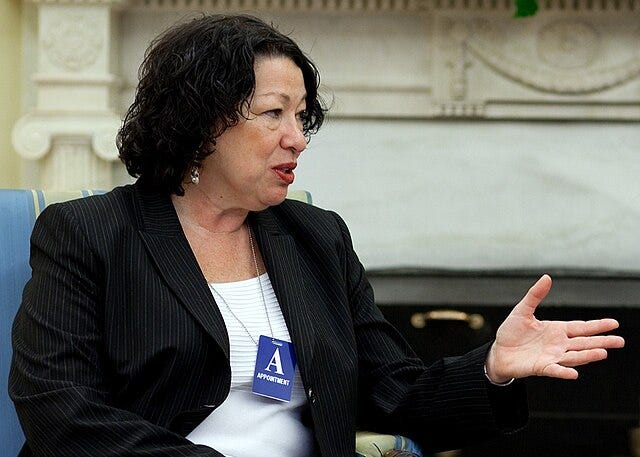
Second Circuit judge Sonia Sotomayor offered that comment on the “difference” that “our gender and national origins may and will make … in our judging” in a 2001 lecture at Berkeley law school titled “A Latina Judge’s Voice.” Her remark would become national news within two weeks of Justice David Souter’s announcement of his retirement in 2009, and it would dog her throughout her confirmation process.
The intense controversy that Sotomayor’s “wise Latina” comment aroused stands in sharp contrast to the lack of attention that Ruth Bader Ginsburg’s incendiary positions received during her confirmation process sixteen years earlier. The difference arose from two dramatic and interrelated changes that had occurred in the meantime.
***
Back in 1993, the Internet did not exist for most Americans. As a Judiciary Committee staffer for Senator Orrin Hatch, I received Ruth Bader Ginsburg’s Senate questionnaire response, with its voluminous attachments, only on paper. The American public did not have easy access to a list of her law-review articles and other writings, much less to the writings themselves. No one—myself included—was in a position to review much of her record beyond her judicial opinions in the extraordinary 86 days that Bill Clinton took to select her.
So during the three weeks between Ginsburg’s nomination and her hearing, it was a big surprise to me to run across a 212-page report that Ginsburg (and her co-author) wrote in 1974 that set forth these explosive propositions:
“Replacing ‘Mother’s Day’ and ‘Father’s Day’ with a ‘Parents’ Day’ should be considered, as an observance more consistent with a policy of minimizing traditional sex-based differences in parental roles.” [p. 133]
“Prostitution, as a consensual act between adults, is arguably within the zone of privacy protected by recent constitutional decisions.” [p. 72]
A statutory restriction on political rights of bigamists “is of questionable constitutionality since it appears to encroach impermissibly upon private relationships.” [pp. 190–191]
“Sex-segregated adult or juvenile institutions are obviously separate and in a variety of ways, unequal.... If the grand design of such institutions is to prepare inmates for return to the community as persons equipped to benefit from and contribute to civil society, then perpetuation of single-sex institutions should be rejected…. While the personal privacy principle permits maintenance of separate sleeping and bathing facilities, no other facilities, e.g., work, school, cafeteria, should be maintained for one sex only…. [G]ender should not be a relevant factor in determining institutional assignments [for prisoners].” [p. 75]
“The Boy Scouts and the Girl Scouts, while ostensibly providing ‘separate but equal’ benefits to both sexes, perpetuate stereotyped sex roles to the extent that they carry out congressionally-mandated purposes.” [p. 131]
The age of consent for statutory rape should be lowered from 16 to 12.* [pp. 69-71 and the specific recommendation regarding 18 U.S.C. § 2032 on page 76.]
Not a single reporter made any mention of this report during the entire confirmation process, and Ginsburg received only one mildly worded question about it during her hearing.
Communications technology had been revolutionized by 2009. Vastly more information was available to anyone looking for it, and any nugget could be shared quickly and broadly.
A diligent researcher at an obscure blog called Verum Serum discovered Sotomayor’s “wise Latina” remark and wrote about it on May 5, 2009, a mere four days after Souter’s announcement. New York Times reporter Charlie Savage ran across the Verum Serum blog post. On May 14, he published an article on Sotomayor’s 2001 speech and observed that she had “described her view of judging in terms that could provoke sharp questioning in a confirmation hearing.” He also posted the full speech, which had been published in the Berkeley La Raza Law Journal.
***
Nearly all Republican senators back in 1993 embraced the “deference” model on Supreme Court nominations. Under that model, they would support a nominee selected by a Democratic president if that nominee met some suitable standard of intellect, character, and experience. The nominee’s judicial philosophy was at best a modest factor in their assessment.
It should seem very strange that Republican senators would abide by the deference model even after Democratic senators had clearly abandoned it, first in their defeat of Robert Bork’s nomination in 1987 and then in their opposition to Clarence Thomas’s nomination in 1991. (Even before Anita Hill surfaced, most Democratic senators were expected to vote against Thomas’s confirmation.)
The explanation I’ve offered is that Republican senators perceived that deference served their individual electoral interests. Their path to re-election was easier if a Supreme Court nomination didn’t become controversial. By invoking the deference approach, a senator acted to preempt any controversy: he sought to ensure that his own party wouldn’t punish him for his support for the Supreme Court nominee of an opposite-party president, and he aimed to win credit from voters of the opposite party and from independents.
Under this deference approach, Republican senators were looking for reasons to be able to vote yes on Ginsburg.
By 2009, many Republican senators would risk a serious primary challenge if they tried to hide behind the deference model. Both political parties had mobilized over judicial nominations and over competing judicial philosophies. Senate Democrats had escalated the battle over lower-court nominations by their unprecedented campaign of partisan filibusters. They had also vigorously contested George W. Bush’s nominations of Chief Justice John Roberts and Justice Samuel Alito.
So Republican senators were now looking for reasons to be able to vote against whomever Obama would nominate. And reasons grounded in judicial philosophy were especially attractive.
***
The National Journal’s Stuart Taylor published an early prominent critique of Sotomayor’s “wise Latina” remark. Taylor acknowledged that part of Sotomayor’s speech “was an unexceptionable description of the fact that no matter how judges try to be impartial, their decisions are shaped in part by their personal backgrounds and values, especially when the law is unclear.” But he powerfully condemned her “wise Latina” sentence:
So accustomed have we become to identity politics that it barely causes a ripple when a highly touted Supreme Court candidate, who sits on the federal Appeals Court in New York, has seriously suggested that Latina women like her make better judges than white males.
Indeed, unless Sotomayor believes that Latina women also make better judges than Latino men, and also better than African-American men and women, her basic proposition seems to be that white males (with some exceptions, she noted) are inferior to all other groups in the qualities that make for a good jurist.
Any prominent white male would be instantly and properly banished from polite society as a racist and a sexist for making an analogous claim of ethnic and gender superiority or inferiority.
Imagine the reaction if someone had unearthed in 2005 a speech in which then-Judge Samuel Alito had asserted, for example: “I would hope that a white male with the richness of his traditional American values would reach a better conclusion than a Latina woman who hasn’t lived that life” — and had proceeded to speak of “inherent physiological or cultural differences.”
Sotomayor’s supporters rushed to defend Sotomayor, or at least to try to explain away her comment. One White House ally contended that Sotomayor “misspoke.” Justice Ruth Bader Ginsburg offered the same feeble defense shortly before Sotomayor’s hearing began: “Think of how many times you’ve said something that you didn’t get out quite right, and you would edit your statement if you could.” But Sotomayor read from a prepared text, and she later published that text as a law-review article.
Others misstated what Sotomayor had said. Judiciary Committee chairman Patrick Leahy was especially brazen. At Sotomayor’s confirmation hearing, Leahy purported to ask her about her comment:
You said that, quote, you “would hope that a wise Latina woman with the richness of her experiences would reach wise decisions.”
Leahy doctored the quote to eliminate the very elements of Sotomayor’s comment that rendered it controversial.
Still others went on the racial offensive by ludicrously contending that critics of Sotomayor’s remark were disputing that a “wise Latina” could exist.
***
The phrase “wise Latina” appears 27 times in the transcript of Sotomayor’s confirmation hearing. Here’s what she had to say about her remark:
The context of the words that I spoke have created a misunderstanding … and to give everyone assurances, I want to state up front unequivocally and without doubt, I do not believe that any ethnic, racial, or gender group has an advantage in sound judging.
Sotomayor implausibly claimed that the “words that I used” were “agreeing with the sentiment that Justice Sandra Day O’Connor was attempting to convey …, which is that both men and women were equally capable of being wise and fair judges.” In fact, in her speech Sotomayor expressly contrasted her position with O’Connor’s. She noted that O’Connor had often been cited for the statement that “a wise old man and wise old woman will reach the same conclusion in deciding cases,” and she stated that “I am … not so sure that I agree with the statement.” That was her set-up for her “wise Latina” comment.
* I learned years later that it appears that Ginsburg made a drafting error and that she instead meant to make the somewhat more modest recommendation that the age of consent for statutory rape under federal law be reduced from 16 to 12 for offenders who were less than five years older than the target.
Kind of had to start blocking nominees after this one.
Empathy is bias? Why are we relitigating this? Just sentences before the famous quote, she explicitly stated: "I do not believe that we should believe that there is any objective stance but only a series of perspectives." Her comment—"I would hope that a wise Latina woman with the richness of her experiences would more often than not reach a better conclusion than a white male who hasn’t lived that life"—was specifically about cases involving race and sex discrimination. She was expressing a hope that the unique life experiences of marginalized groups provide valuable insights into civil rights issues that someone who hasn't faced those barriers might miss. She was not asserting biological superiority; she was highlighting the value of lived experience in a justice system that had historically excluded those perspectives.
In addition, a review of her extensive judicial record contradicts this narrative in several key ways while your interpretation suggests the "wise Latina" quote amounts to a confession of prejudice.