


In his presidential campaign in 2008, Barack Obama presented his “empathy” standard for selecting Supreme Court justices and lower-court judges. John McCain, his Republican rival, countered by defending the imperative of judicial dispassion.
Obama would win the 2008 election, but he would lose the broader rhetorical battle over the proper role of judges: His own two Supreme Court nominees would repudiate his empathy standard.
* * *
Barack Obama first articulated his empathy standard as a rookie senator in 2005, when he explained his decision to vote against the confirmation of John Roberts as chief justice. Roberts, Obama said, “does, in fact, deeply respect the basic precepts that go into deciding 95 percent of the cases that come before the Federal court -- adherence to precedence, a certain modesty in reading statutes and constitutional text, a respect for procedural regularity, and an impartiality in presiding over the adversarial system.” But “what matters on the Supreme Court is those 5 percent of cases that are truly difficult”:
In those cases, adherence to precedent and rules of construction and interpretation will only get you through the 25th mile of the marathon. That last mile can only be determined on the basis of one’s deepest values, one’s core concerns, one’s broader perspectives on how the world works, and the depth and breadth of one’s empathy.
In those 5 percent of hard cases, . . . the critical ingredient is supplied by what is in the judge’s heart.
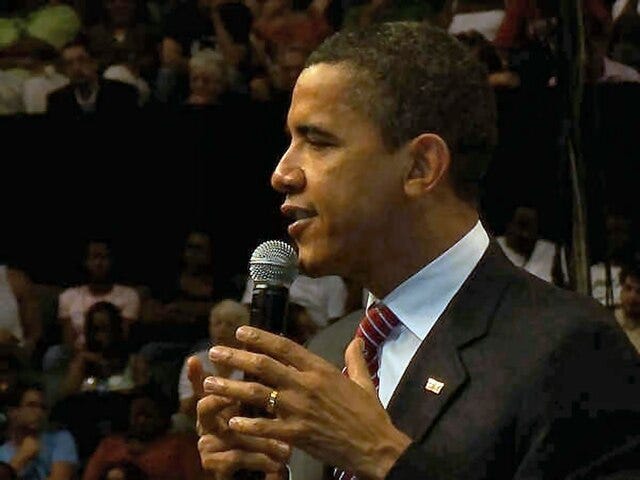
On the presidential campaign trail in July 2007, Obama reiterated his empathy standard in his presentation to the Planned Parenthood Action Fund:
Ninety-five percent of the time. Justice Ginsburg, Justice Thomas, Justice Scalia they’re all gonna agree on the outcome.
But it’s those five percent of the cases that really count. And in those five percent of the cases, what you’ve got to look at is—what is in the justice’s heart. What’s their broader vision of what America should be. Justice Roberts said he saw himself just as an umpire but the issues that come before the Court are not sport, they’re life and death. And we need somebody who’s got the heart—the empathy—to recognize what it’s like to be a young teenage mom. The empathy to understand what it’s like to be poor or African-American or gay or disabled or old—and that’s the criteria by which I’ll be selecting my judges. Alright?
John McCain contested Obama’s vision of the judiciary in a speech in May 2008. “The proper role of the judiciary,” he observed, “has become one of the defining issues of this presidential election”:
My two prospective opponents [Obama and Hillary Clinton] and I have very different ideas about the nature and proper exercise of judicial power. We would nominate judges of a different kind, a different caliber, a different understanding of judicial authority and its limits. And the people of America — voters in both parties whose wishes and convictions are so often disregarded by unelected judges — are entitled to know what those differences are.

McCain faulted Obama and other Democrats for waging “tense confirmation battles [on] the suspicion that maybe, just maybe, a nominee for the Court will dare to be faithful to the clear intentions of the framers and to the actual meaning of the Constitution.”
The “vague words” of Obama’s empathy standard, McCain charged, “attempt to justify judicial activism—come to think of it, they sound like an activist judge wrote them”:
And whatever they mean exactly, somehow Senator Obama’s standards proved too lofty a standard for a nominee who was brilliant, fair-minded, and learned in the law, a nominee of clear rectitude who had proved more than the equal of any lawyer on the Judiciary Committee, and who today is respected by all as the Chief Justice of the United States.
McCain faulted Obama for voting against Samuel Alito (whose nomination he also attempted to filibuster) as well as John Roberts:
I have my own standards of judicial ability, experience, philosophy, and temperament. And Chief Justice Roberts and Justice Samuel Alito meet those standards in every respect. They would serve as the model for my own nominees if that responsibility falls to me….
My nominees will understand that there are clear limits to the scope of judicial power, and clear limits to the scope of federal power. They will be men and women of experience and wisdom, and the humility that comes with both. They will do their work with impartiality, honor, and humanity, with an alert conscience, immune to flattery and fashionable theory, and faithful in all things to the Constitution of the United States.
* * *
McCain also advocated the obsolete model of senatorial deference to the president on Supreme Court picks. He pointed out that he had voted for Bill Clinton’s nominations of Ruth Bader Ginsburg and Stephen Breyer for what he said was “the simple reason that the nominees were qualified, and it would have been petty, and partisan, and disingenuous to insist otherwise”:
Those nominees represented the considered judgment of the president of the United States. And under our Constitution, it is the president’s call to make.
In the Senate back then, we didn’t pretend that the nominees’ disagreements with us were a disqualification from office even though the disagreements were serious and obvious. It is part of the discipline of democracy to respect the roles and responsibilities of each branch of government, and, above all, to respect the verdicts of elections and judgment of the people.
* * *
Obama didn’t persuade McCain of the merits of his empathy standard. But perhaps he did persuade him that it is permissible—indeed, necessary—for senators to stand against Supreme Court nominees selected on the basis of that unsound standard: In 2009 and 2010, McCain would end up voting against Obama’s nominations of Sonia Sotomayor and Elena Kagan.
I kept reading "empathy standard" as "empty standard." Sounds about right.