


With gratitude to Steve Matthews for his accounts (here, here, and here) of his role in judicial selection in the Reagan administration, I now turn to his own nomination two decades later.
Shortly after the 2006 Senate elections gave Democrats control of the Senate in 2007, Fourth Circuit chief judge William Wilkins announced that he would take senior status on July 1, 2007. In September 2007, George W. Bush nominated Matthews to fill Wilkins’s Fourth Circuit seat. Senate Democrats never gave Matthews a confirmation hearing, and the Senate returned his nomination to the White House in January 2009, weeks before Barack Obama became president.
Matthews and I discuss his experience as a nominee, including the fate that his nomination (and many other Bush nominations) shared with Merrick Garland’s nomination to the Supreme Court in 2016.
Q. How did you decide that you were interested in the Fourth Circuit seat? How hopeful were you of getting confirmed?
I had never thought of being a judge. Most of my practice had been advisory and transactional, rather than along the litigation path that most judges had followed. Indeed, for the previous six years, I had served as managing partner of my firm, with few actual practice responsibilities. I was quite comfortable in the roles that I had, including as an occasional quiet advisor to various elected officials.
I had a decent relationship with both of South Carolina’s senators, Lindsey Graham and Jim DeMint. In fact, I was included in what Senator Graham referred to as his “Founders Group,” a group of early contributors to his first senatorial campaign who met with him two or three times a year to hear from him, and to give feedback, on various current policy issues. During those meetings, I became acquainted with his chief aide on Judiciary Committee matters, James Galyean. The Senator and James knew of my prior work in judicial selection for President Reagan.
Because Judge Wilkins was a South Carolinian, it was expected that a South Carolinian would be nominated to replace him. On the morning that his retirement hit the news, James called. I expected immediately that he was calling to ask for my recommendations of possible candidates and, perhaps, for assistance in vetting candidates. I was mistaken.
When I returned the call, James said that Senator Graham had asked him to put together a list of candidates to consider in formulating recommendations to the White House; and he asked if he could put me on the list that he would provide to the Senator. Although flattered, I thanked him but declined. I was about to send the first of three children off to college; I enjoyed my life and practice; and life as a judge had never held any particular appeal for me. Although some lawyers view judges (and some of them view themselves) as the next thing to gods, I always saw them simply as public servants fulfilling a vital but on most days not terribly interesting role.
James asked me at least to think it over for a while and discuss it with my wife. So, that evening, I told Caroline about the call and that I had declined. She then reminded me of a candidate for a Court of Appeals seat whom I had met while I was doing judicial selection and she and I had first begun dating. Lee Liberman (now Lee Otis) and I interviewed him together. He was active in local Republican politics, which many candidates were; and there was nothing about his résumé that was particularly distinguishing. On every question and on every follow-up, however, he showed a sophistication and depth that was breathtaking. As we walked away from the interview, Lee said in wide-eyed amazement, “He has no right to be that smart!” After some fits and starts, we successfully got him through the DOJ approval process, but he declined further consideration because it did not fit with other commitments he had just made.
I seldom discussed work outside of the office; but at the time I did complain to Caroline that it was hard enough to find good candidates, and that when one of them had the opportunity to serve, he really had an obligation to accept. So when I told her about my call from James Galyean, her only comment was, “You can’t be the person you complained about.”
The next day, I called James back and told him that it would be an honor to have my name on the list that he was preparing for the Senator. I knew that the likelihood of my name advancing much beyond that was remote and that I could allow my name on the list, clear my conscience, and have no real consequence.
A couple of days later, however, the White House called. The question was the same: would I be willing to be considered for the Wilkins vacancy on the Fourth Circuit. I laughed, explained about James’s call and Caroline’s comment, and said that I would be honored to be considered. I learned then, however, that the White House was calling not because of any recommendation from Senator Graham (who had not yet provided any recommendations), but because others who knew me and my judicial philosophy from my days in the Justice Department or from other connections had contacted the White House to recommend me.
Of course, I and everyone else involved knew that the recent election meant confirmations would be considerably more difficult. But the extent of that partisan obstructionism was not yet clear; and in any event it was two years until the next election. A delay of that length seemed unlikely.
As it happened, I was not nominated until 10 months later. By the time of the nomination, the senatorial roadblock to President Bush’s judicial and other nominations was becoming apparent. Combined with the fact that I had never been a shrinking violet about my judicial philosophy or other opinions, that situation did not portend a strong likelihood of success for my nomination.
Q. How did the selection process you went through differ from the process you were involved in during the Reagan administration?
The Administration’s selection process (or at least those parts of that I could see) was remarkably similar to that during my time at DOJ.
The significant difference was the place and style, but not the content, of the interviews. Rather than a series of one-on-one interviews at DOJ, I had two group interviews—one at DOJ and one at the White House. My interview at the Justice Department was done by Attorney General Alberto Gonzales and, if I recall correctly, Kyle Sampson, his chief of staff; Rachel Brand, head of the Office of Legal Policy; Elisebeth Collins, deputy in OLP; and perhaps others. The White House interview was conducted by White House counsel Harriet Miers, deputy counsel Bill Kelley, and associate counsel Jennifer Brosnahan.
The sorts of questions asked at both interviews were remarkably similar to those we asked when I was on the other side of the table.
Q. How did your experience in selecting judges prepare you for your own selection?
The major way in which my prior experience prepared me was that I went into the interviews with an understanding of, or at least a strong view about, what the interviewers needed to find out about me. If they liked what they learned about me, that was all well and good. If they did not like what they learned about me, that was fine also. I was not there to convince them that I was the right candidate for the nomination.
My job in the process was to make sure that they understood my approach to the role fully and correctly. On the basis of that, they would decide whether I was the right candidate. With that understanding and with an intervening 20 years’ worth of development of originalist/textualist concepts through Thomas and Scalia opinions and reams of scholarship, I think my interviews were more efficient and accurate in presenting to my interviewers just what my jurisprudential outlook was than were interviews that I had conducted way back when. Of course, my interviewers were aware of my earlier work in the Department and how I had conducted it; and so they also went into the interviews with a starting point well advanced from what had usually been my own starting point.
One of the minor ways in which my prior experience prepared me showed up at the end of the White House interview. White House counsel Miers excused her deputies from the room and began, very apologetically: “There are some questions that I have to ask. Please don’t think that we have heard anything negative about you or that there are any derogatory rumors. We’ve not heard any such thing. But we need to protect the President and to make sure that his nominees don’t become an embarrassment to the Administration.”
At that point, I interrupted and said, “Ms. Miers, please remember that I did this 20 years ago. I had to ask the same questions that you’re getting ready to ask now. I know what you’re going to ask and why you have to ask it. No need to be embarrassed.” With a sigh of relief, she said, “Oh, yeah. I guess that’s right. Okay . . .” and proceeded to ask if I had gambling or other heavy debts, drank heavily, cheated on my wife, used drugs, etc. (For the record, the answers all were and still are an honest “No.”)
Q. Describe how the confirmation process went.
In light of the Democratic majority’s determination to run out the clock on almost all appellate court nominations, the confirmation process can best be described—despite the best efforts of the White House, the Justice Department, and the Republican minority—as a charade.
White House legislative affairs and Senator Graham attempted the usual series of meetings with influential senators and staffers on both sides of the aisle. I had personal meetings with Senator Kennedy, Senator Durbin, Democratic Congressman James Clyburn of my home state, and Democratic Congressman John Spratt of my home state with whom I also shared a Yale Law School connection.
Senator Leahy, however, refused to meet with me. So, when I was walking through the Capitol one day with Harold Kim of White House Legislative Affairs on the way to one of our scheduled meetings and happened to see Senator Leahy waiting for an elevator, I dashed over, put out my hand, and said “Hello, Senator.” As he smiled and shook my hand, I continued, “I’m Steve Matthews, the President’s nominee to the Fourth Circuit from South Carolina.” The smile, in fact all expression, left his face; and he jumped into the elevator that had just arrived.
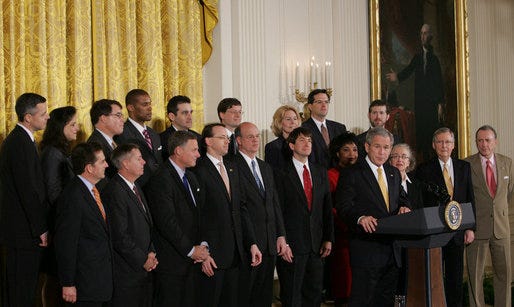
Senator Graham relayed to me on a couple of occasions that Senator Leahy had promised to schedule a hearing for me; however, that never happened. The Senate’s delay became so protracted and widespread that the White House scheduled a special, C-SPAN televised event one morning in February 2008 in the East Room. President Bush, flanked by me and others, but not nearly all of his pending judicial and other nominees, called out the Democratic majority in the Senate for shirking its responsibility to advise and consent by giving up-or-down votes on nominees duly submitted by the executive branch. In response, Senator Leahy relayed through Senator Graham that he had been “just about to” schedule hearings but would now refuse because the President had “politicized” the issue.
Q. How would the Steve Matthews of 1987 have assessed the judicial candidacy of the Steve Matthews of 2007?
Unsurprisingly, I would have approved. While working in judicial selection, I was looking for candidates who agreed with President Reagan on the judicial role. I had undertaken that work because I myself agreed with the President on that point (as I did on many others). In other words, by a sort of jurisprudential transitive property, I was looking for someone who agreed with me. As my judicial philosophy had not changed in the intervening years, I think the 50-plus-year-old me would have been an attractive candidate to the 30-year-old me.
Q. When Senate Republicans obstructed Merrick Garland’s nomination to the Supreme Court in 2016, liberal academics suddenly started advancing the wacky claim that the Constitution requires that the Senate hold an up-or-down vote on a Supreme Court nominee. The same Appointments Clause of course applies to lower-court nominees as to Supreme Court nominees. You must have been bemused by this episode.
Not so much “bemused,” really. I had long since stopped expecting any commitment to principle from those who deny that the Constitution embodies any. A better word may be “gratified.”
The same procedural ploy that kept me off of the Fourth Circuit kept Merrick Garland off of the Supreme Court. And I’ll take that tradeoff eight days a week.