


Anyone with significant experience in judicial selection is going to have some regrets. During his years in the Reagan administration working for Attorney General Edwin Meese, Steve Matthews was assigned to vet Anthony Kennedy’s candidacy for a Supreme Court nomination and wound up strongly opposing that nomination.
I continue my interview with Matthews.
Q. You completed a thorough review of then-Ninth Circuit judge Anthony Kennedy’s judicial record in 1985, more than a year before President Reagan made Kennedy his third pick to replace Justice Lewis Powell. Tell us how that came about.
On my first day in the Justice Department in June 1985, before I even had a desk, I was informed of a project to review possible candidates—all of whom were sitting Court of Appeals judges—for a Supreme Court nomination, should another vacancy occur during President Reagan’s term in office. [EW: Reagan had appointed Sandra Day O’Connor in 1981.] A small group inside the department was conducting the review; and each member of the group was assigned one of the potential nominees.
The task was to read every opinion (majority or dissent) written by or (if of any jurisprudential significance) joined by that judge; to write a synopsis of each such case summarizing and evaluating the judge’s work; and to then prepare a memorandum presenting an overarching analysis of that judge’s work. Non-judicial writings, speeches, and available interviews were also included. The judges did not know that they were being evaluated.
After the project was described to me, I was told that I was being assigned Judge Anthony Kennedy of the Ninth Circuit, a name that I had never before heard. After nearly a year, I had finished studying several hundred opinions, had prepared synopses ranging from one page to five or more pages on well over 100 of them, and had prepared the comprehensive memorandum. [EW: The memo is in the public domain.]
I learned during the process that Ed Meese had played an important role in Judge Kennedy’s getting on the Ninth Circuit in the first place. President Ford had nominated Judge Kennedy to the Ninth Circuit on the recommendation of Ronald Reagan who, in turn, had relied on the recommendation of Ed Meese. That knowledge made it uncomfortable for me to offer a negative opinion on Judge Kennedy as a Supreme Court candidate; but my analysis of his writings made that negative opinion necessary. By that point, I knew the Attorney General well enough to know that he expected a completely honest, professional opinion.
Q. What concerned you about Judge Kennedy’s record?
As I noted in my memo, Judge Kennedy’s record was mixed; and I was of the view that one should not take chances on a Supreme Court nominee. But my main point of concern was that Judge Kennedy was simply too comfortable with the notion that a judge could ad lib constitutional rights with no textual or historical support—the “living Constitutionalism” of Justice Brennan. This showed up most clearly in his 1980 decision upholding restrictions on service by homosexuals in the Navy on the narrow basis that the usual constitutional rules do not apply in the armed services, with a strong and clear suggestion that he would have decided differently had the issue arisen in society at large. The contrast with a 1984 decision on the same issue by Judge Bork on the D.C. Circuit (also one of the candidates being reviewed) was stark. (Both decisions were before the Court’s 1986 ruling in Bowers v. Hardwick.)
I concluded the comprehensive memorandum with the analysis of that case and the statement that “This [Judge Kennedy’s] easy acceptance of privacy rights as something guaranteed by the Constitution is really very distressing.” There were other aspects of Judge Kennedy’s jurisprudence as reflected in his written record that were also troubling (for example, voting rights in a water district, and avoidance of statutes of limitations for a sympathetic plaintiff).
Brad Reynolds, who was chairing the review project, told me later that, upon reading the analysis, Judge Kennedy fell from near the top of his list to the bottom. As it happened, however, that fact did not become relevant for a while. The top two on the list were, by a wide margin, Judge Bork and Judge Scalia.
Q. How did Kennedy end up getting nominated?
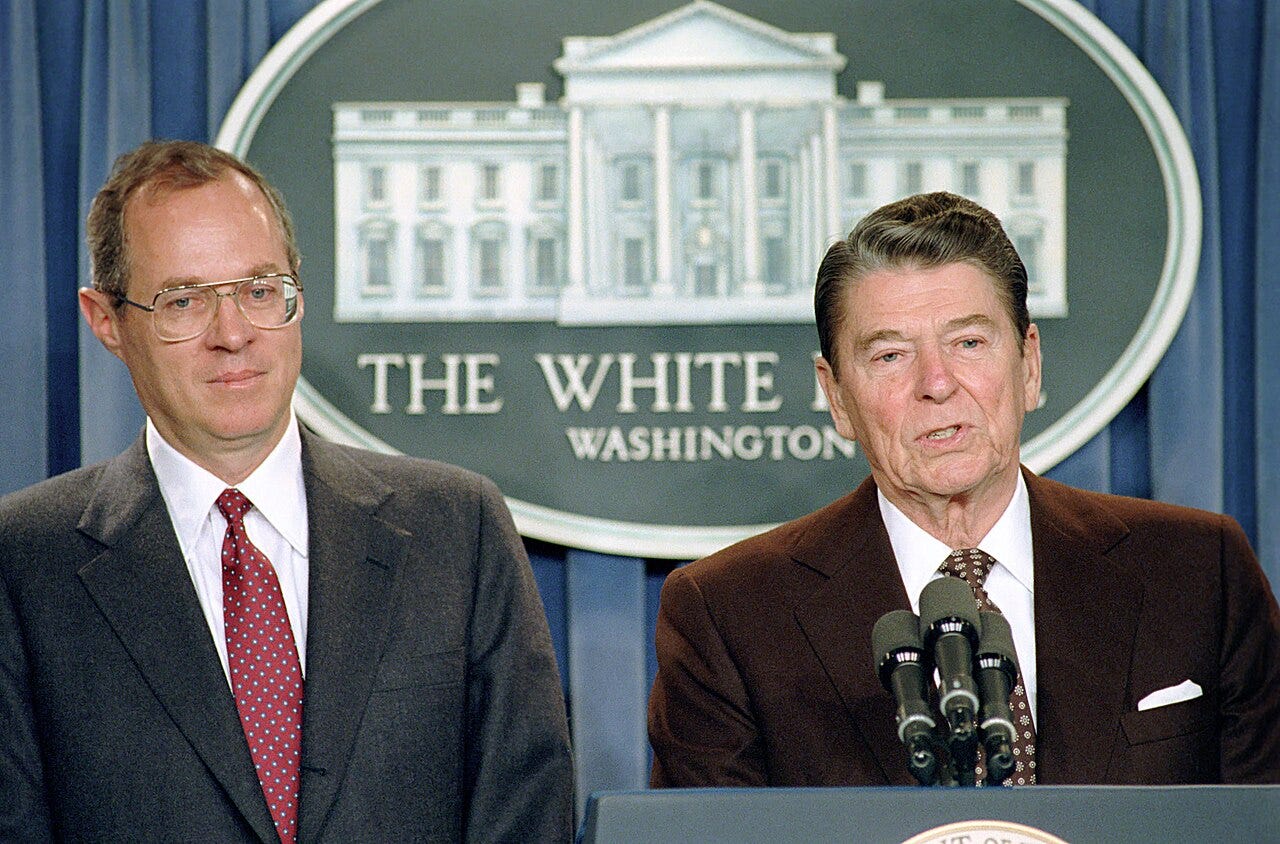
When Chief Justice Burger retired in 1986, President Reagan selected Judge Scalia (for actuarial reasons, so I understand), with Rehnquist moving up to Chief; and in 1987, he selected Judge Bork for Justice Powell’s vacancy. When Judge Bork’s nomination was murdered by a cabal of clowns, cretins, and degenerates in the Senate, there was an effort by some in the White House to move immediately to Judge Kennedy, on the grounds that the Democratic Senate majority had signaled that they found him unobjectionable. However, personnel in the Department (I think in large measure because of my analysis) were still game for a fight, and successfully recommended to the President that he select DOJ alumnus Judge Douglas Ginsburg. But when that selection fell through, confirmability without controversy became the order of the day, at the political level. That, combined with the fact that some involved in the process believed my gloomy prognosis for a Kennedy appointment to be mistaken, made his nomination unavoidable.
Q. Any second thoughts on your opposition to Kennedy?
Twenty years later, a few weeks before I was nominated for the Fourth Circuit vacancy, Jan Crawford’s book Supreme Conflict came out and recounted portions of my memorandum. I had described my role and my view in that process to the folks working on the nomination in the White House and in DOJ very early in the process, so it was not news to them. But there was certainly the prospect that it might complicate confirmation, which was already uncertain at best, given the 2006 election results.
In one of my last visits with my father, then recently hospitalized in what was his (fortunately very brief) final illness, I told him about the book. He put everything in perspective with a three-word question and a three-word statement. He asked, “Were you right?”; and when, with knowledge of Justice Kennedy’s first 20 years on the Court, I responded “100 percent!”, he said “Nothing else matters.”
Bork was not defeated by clowns, cretins and degenerates. He was given full hearings and a vote and rejected. 6 Republicans voted against him. Even John Stennis of Mississippi, past leader of Southern segregationists, voted against him.
Both you and Matthews are reactionaries.