


Few federal judicial nominees had as much previous experience with the judicial-selection process as Steve Matthews. As a young attorney in the Department of Justice in the Reagan administration, Matthews was deeply involved in the judicial-selection process for lower-court judges. From 1986 to 1988, he led the process for Attorney General Edwin Meese.
When I contacted Matthews to learn about his nomination by George W. Bush to a Fourth Circuit seat in 2007, I discovered that he had a wealth of interesting recollections from his Reagan days. Matthews generously agreed to talk with me about his experience, including his prescient assessment of Anthony Kennedy’s fitness for the Supreme Court.
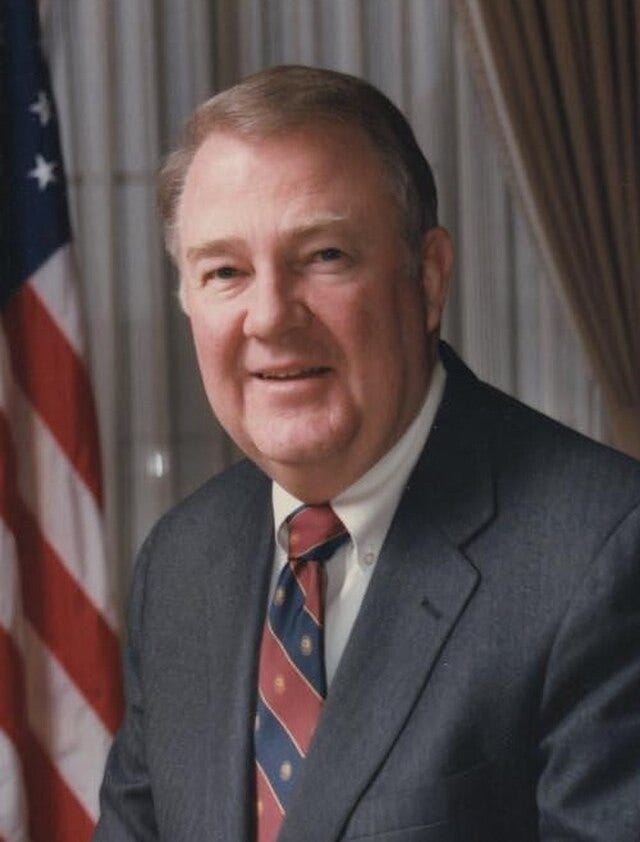
Q. How did you get involved in judicial selection for the Reagan administration?
I was hired by Attorney General Edwin Meese shortly after his move to the Department of Justice. I was in private practice with a Wall Street firm in its D.C. office. Although I had been a great admirer and supporter of President Reagan since 1968 and was in full accord with what he and Ed Meese hoped to accomplish in the jurisprudential arena, I really had no desire or intention to go into the government. My good friend Ken Cribb, who was Ed’s most trusted lieutenant, asked me to meet with the new Attorney General to see if there might be a role in his Department of Justice that would allow me to serve where I thought I could make a valuable contribution.
When I met with Ed, after a fairly lengthy conversation, he said that he would like for me to come in to serve as Deputy Associate Attorney General to Brad Reynolds, who had been nominated to be the Associate Attorney General, and that a significant part of the responsibility of that role would be in the judicial selection process. Because I knew that that process would be one of the most significant parts of President Reagan’s legacy and because of my very longstanding concerns with errors in that process during prior administrations and with the jurisprudential attitude that a great many previous Presidents’ nominees brought to the bench, I found myself – somewhat to my surprise – immediately saying yes; and I joined the Department in June 1985.
Of course, as it turned out, Brad Reynolds was not confirmed; so for my first eight months or so, I was housed in the Civil Division and in the Civil Rights Division. During that time, I handled a number of responsibilities that would have been in my planned portfolio, including in the judicial-selection process—and, most importantly in that regard, on the internal committee looking at potential nominees for the next Supreme Court vacancy.
When Stephen Markman, longtime aide to Senator Orrin Hatch, was confirmed as Assistant Attorney General in the Office of Legal Policy in the early spring of 1986, I became Deputy Assistant Attorney General in that Office, where my nearly-but-not-quite sole responsibility was overseeing the judicial selection process.
Q. Describe the judicial-selection process for lower-court judges when you were running it.
The process was essentially the same throughout the two terms of the Reagan presidency, although the key personnel involved centered around Mr. Meese in both terms and, consequently, were more active in the White House during the first term and in the Department of Justice during the second term.
During my involvement, the process operated in this fashion. When a vacancy occurred in a district court seat, we would ask the Republican senator or senators from the State (or the most senior locally relevant Republican member of Congress if there was no Senator) for 3 to 5 recommendations. Our commitment was that, unless all recommended prospects were for whatever reason unacceptable, we would confine our consideration to those recommendations. For circuit court vacancies, we would receive and consider recommendations from those Republican senators or representatives but would not limit ourselves to only those recommendations; we would, instead, undertake our own search for possible candidates.
Of course, the willingness of senators to accept those terms of engagement varied broadly, especially with regard to district court appointments. Some would serve as an honest broker and provide 3 to 5 bona fide recommendations; some would insist that it was their prerogative to choose the nominee and insisted that they would provide only one recommendation; and some would publicly provide a large number of names, and get credit from each of them for having done so, but would then quietly explain that only one was a real recommendation and that that one must be chosen. Senatorial insistence on a single candidate for a circuit court vacancy was rare, but it did happen.
Q. How did Attorney General Meese decide among the competing candidates?
Once a person was in the mix, we invited that person to come to Washington on his/her own dime, for interviews with various officials and staffers in the Department. We did not explain in advance what the nature or scope of the interviews would be. Some told us (or otherwise demonstrated) that they had heard from other candidates or from media reports what to expect, but their expectations were usually wrong. One fairly young candidate confided that he was expecting (or dreading) a sort of bar exam, with questions about the finer points of the Federal Rules and a whole host of federal statutes that were not familiar to his small-town practice.
In fact, our questions were intended to determine (in addition to basic quality of legal education and acumen) whether the person’s view of the judicial role was in line with that of President Reagan, that is, fidelity to the Constitution and laws as written and ratified or enacted. In phrases not yet then current, this was “original public meaning” and “textualism.” We presented hypothetical scenarios, posing legal issues arising from such a hypothetical, and asked how the candidate would go about analyzing those questions or resolving apparent conflicts in legal principles, with each response then eliciting from us follow-up questions or counter-points.
As I described then what I was looking for in those interviews, it had three elements: an understanding of what the sources of law are (and what they are not) and the hierarchy of those sources; the intelligence to read and understand those legal sources; and the intellectual humility to keep one’s own preferences out of the consideration and to declare what the actual law actually requires. On that last point, there was a cautionary “tell” for which I kept an eye out. If I could see that someone really wanted to be a judge (as opposed to someone who was willing to serve in that role, if asked), my sensitivity would elevate on that question of ability to divorce one’s personal preferences from legal mandates.
The interviewers always included me and Steve Markman, and usually included others who were deputies to the assistant attorneys general or special assistants to the Attorney General. We did the interviews one-on-one or occasionally two-on-one.
In tandem with the interviews, we also conducted informal background checks by telephone calls to people in the State who were viewed favorably by the Administration and to State bar association officials. In addition, where there was a publicly available written record (rare for district court candidates; more frequent for circuit court candidates who were already on a district court or who were coming from an academic background), we would examine that as well.
Once we completed the interviews of a candidate, we would combine the interviewers’ observations, noting where there were concerns or disparities in interviewers’ reactions to the candidate and/or where the candidate had done especially well. Once we had interviewed all of the candidates for several vacancies, we would meet with Attorney General Meese. We would present to the Attorney General, for each vacancy, the pluses and minuses of each candidate and, for each vacancy, a ranking of the candidates. Following discussion, Ed would select a candidate to recommend to the White House for each vacancy.
Q. What happened after Attorney General recommended a candidate to the White House?
Consideration at the White House was undertaken by a committee chaired by White House counsel that met about once a month. Attending from the Department were the Attorney General, Ken Cribb, Steve Markman, and me. From the White House, the participants were, in addition to the White House counsel and his deputy, the director of personnel, the legislative affairs director, and the state affairs director (and perhaps others – my memory of who was around the table is not complete). At that meeting in the Roosevelt Room, for each vacancy, the Attorney General would present a single name, the one that he had selected. Other candidates who had not been selected were usually not discussed unless some Senator was making a hard push for a non-selected candidate. In the great majority of cases, the Attorney General’s recommendation was accepted by the White House committee.
At that point, the name was given to the FBI for a full background check and to the ABA for rating by its Standing Committee on the Judiciary. (Even then, we had some problems with leftist bias by the ABA Committee.)
Unless the FBI review disclosed a problem (which I recall happening only twice, although there may have been others), the President made the nomination. From that point, most nominations proceeded to a hearing and vote, subject to the usual Senatorial wrangling, vote-trading, etc.
Q. The conservative legal movement was in its infancy in the 1980s. I would think that there were very few candidates well versed in what we now regard as conservative judicial principles. How did you find good judges?
You’re quite right. Few lawyers, and for that matter few sitting judges, at that time thought seriously about the jurisprudential concerns that are now a staple of legal discourse. None of them had had the opportunity, as law students or as practitioners, to have studied opinions of Justice Thomas or Justice Scalia or Justice Alito or Judge Bork. Nor had they had the opportunity to have read the scholarship of Richard Epstein or John Harrison or Steve Calabresi. So, few people (including the candidates themselves!) knew what a candidate’s considered opinion on jurisprudential points would be. Beyond that, as noted earlier, for district court seats (other than the District of Columbia and a few states where we had a free hand), we were pretty much confined to the list of recommendations from the Senators or congressional delegation. Our job then was to choose the best from that list. Among the recommendations presented to us, we used the interview tools described above. To locate possible alternatives, we made us of our extensive combined network of contacts throughout the country and scoured the available writings of academics and lower court judges. Although I’m sure that we sometimes missed great prospects, we nevertheless did find a surprising number of them.
Q. During the first part of your time in DOJ, Republicans controlled the Senate. But Democrats won control in the 1986 elections. How did that change of control affect your selection of judicial candidates?
For the most part, it didn’t. Regardless of which party controlled the Senate, we were looking for the best candidate who understood and agreed with the President’s view of the role of the federal judiciary. After the 1986 mid-terms, there were (so I understand) some more accommodationist personnel in the White House who preferred to avoid fights and preserve political capital (although for what purpose, I never understood – all political capital would evaporate on January 20, 1989). That mindset never really had an impact on the lower courts; and where it appeared at the Supreme Court level (with some in the White House preferring Judge Kennedy), the President himself chose first Judge Bork and then Judge Douglas Ginsburg before finally agreeing to a more-easily-confirmable Judge Kennedy.
***
In my next interview segment, Matthews will discuss his review of Anthony Kennedy’s candidacy for the Supreme Court as well as his role in the selection of two judges he is particularly proud of: D.C. Circuit judge David Sentelle and Fourth Circuit judge Paul Niemeyer.