


As we have seen, Ronald Reagan’s selection of Anthony Kennedy as his third pick to fill Justice Lewis Powell’s seat is the nomination that Steve Matthews, then working for Attorney General Edwin Meese, most wishes he had been able to prevent. Continuing my interview with Matthews, I turn to happier matters.
Over the past several decades, as the conservative legal movement has flourished and as communications technology has advanced, it has become much easier for conservative judge-pickers to identify quality candidates. Steve Matthews in the mid-1980s did not have those advantages. Serendipity—in the form of encounters at a symposium a decade earlier and at a friend’s wedding—played an important role in two of his favorite recommendations: David Sentelle and Paul Niemeyer.
Q. Are there any of your judicial selections that you’re especially proud of?
With the caveat that I made only recommendations and that the actual picks were made by the President on collaborative advice, there are several nominations in which I had a more determinative role that generated, in my estimation, really great jurists.
I’ll highlight two of them here. The first is David Sentelle, now a senior judge on the Court of Appeals for the D.C. Circuit.
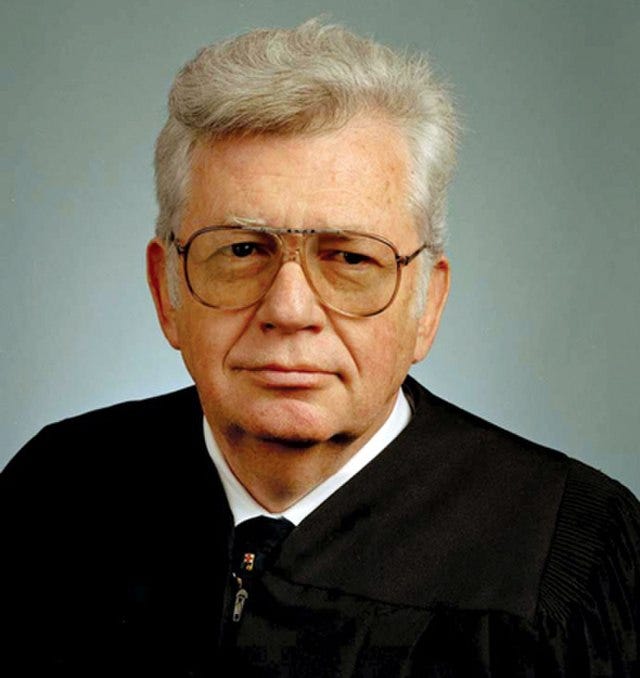
Q. How did Judge Sentelle come to your attention?
In October 1985, I met with the then-acting Assistant Attorney General for Legal Policy regarding pending vacancies. He said that we had a vacancy on the D.C. Circuit, that the nominee could come from anywhere, and that our direction was to choose from among the district court judges picked by President Reagan. He handed me a list of all those district-court selections and asked, “So, who should it be?”
Having been a corporate finance lawyer, not a litigator, prior to joining the Administration, I recognized only a very, very few (and then only very vaguely) of the names on the list, who in any event had been judges for a few years at most. As I looked down the list, however, I came across the name of David Sentelle of North Carolina.
As an undergraduate at the University of South Carolina in the mid-1970s, I had been a professor’s guest at a symposium of the North Carolina Conservative Society and had there met then-State Court Judge David Sentelle. Over that weekend, I had come to realize that he was not only completely unassuming but also amazingly intelligent, incredibly erudite, and genuinely decent. I circled his name, handed it back, and said “Here’s the guy!”
I think my interlocutor was surprised that I actually knew anyone on the list. But he was familiar with Judge Sentelle, who, it turns out, was confirmed by the Senate to his district-court seat that very month, and he agreed that he would be a great choice.
As it happened, we instead moved an outstanding candidate, Stephen Williams, who had been initially selected for another Circuit into this D.C. Circuit seat.
Q. But another opportunity soon arose.
When Judge Scalia’s elevation to the Supreme Court created a D.C. Circuit vacancy in the fall of 1986, I recalled my previous recommendation of Judge Sentelle, and I enthusiastically encouraged his nomination. We had to go through the usual process of interview and background check, along with a somewhat convoluted selection process that concluded after the Republicans had lost the Senate in the 1986 midterm elections.
I knew that we had made the right choice during Judge Sentelle’s confirmation hearing, when one of the Senators (either Leahy or Simon, as I recall) tried to cow him into promising to resign from his Masonic lodge because it had no women members and, according to the Senator, no black members. Judge Sentelle politely reminded the Senator that the Masons are a “fraternal” organization and so would not have women members and that, although he (having not attended in quite some time) did not know whether his own lodge had any black members, there certainly were black Masons. He concluded, with a quiet courage that had been lacking when other nominees had been browbeaten by preening Senators over membership in some innocuous social organization, by stating (a paraphrase from memory): “Senator, the men in my family have been Masons for 200 years. If my membership causes you any concern about my suitability for this position, my resignation now should not allay those concerns. And no, Senator, I will not resign.”
Everything about the ensuing decades of Judge Sentelle’s service on the D.C. Circuit confirms my opinion that he is one of the truly great ones.
Q. Let’s turn to the other selection you’d like to highlight.
The other is Paul Niemeyer of the Fourth Circuit. He was elevated to that court by President George H.W. Bush, after my departure from D.C., from the Maryland district court bench to which President Reagan had appointed him with my participation.
Like Judge Sentelle, Judge Niemeyer has been one of the really excellent judges of the past several generations. In 1987, we had a vacancy on the district court in Maryland. With no Republican senator in Maryland, we turned to the congressional delegation from which we received only a single recommendation—a municipal judge who simply did not have a suitable background and experience.
Left to our own devices, I contacted a prominent businessman in Baltimore whom I had met at his nephew’s (my friend’s) wedding four years earlier and asked him to tell me who the really good civil litigators were in Baltimore. He gave me Paul Niemeyer’s name.
I called Paul, then a partner at Piper & Marbury, asked a bit about his practice (which was impressive), and then asked if he would be willing to be considered for a judicial appointment to the district court. His first response was that he really was not interested, had never thought of the judiciary as particularly appealing, and enjoyed what he was doing at his law firm. I suggested that he think about it for a while and that we talk again later, to which he agreed.
Before concluding the conversation, however, and in light of his somewhat unusual last name which was shared by a professor of political philosophy whom I had known for about ten years, I said, “By the way, I have to ask, are you familiar with another Niemeyer, Professor Gerhart Niemeyer?” With some obvious surprise, he responded “Well, yes. He’s my dad.”
That was the clincher. I knew that anyone who had grown up under Professor Niemeyer’s tutelage would be well-acquainted with the jurisprudential philosophy and habits of mind that we were looking for. And, indeed, he has been exactly that. After another call or two, he agreed to be considered, was duly appointed to the district bench, and then later to the Court of Appeals.
* * *
Judge Sentelle continues to serve on the D.C. Circuit. He became a senior judge on that court in 2013.
More than 35 years after George H.W. Bush elevated him to the Fourth Circuit, Judge Niemeyer remains in active status.
How many GOP nominees, even today, would lack the courage to give the answer that Judge Sentelle gave!