


“I was completely disgusted by Judge Sotomayor’s testimony today. If she was not perjuring herself, she is intellectually unqualified to be on the Supreme Court. If she was perjuring herself, she is morally unqualified. How could someone who has been on the bench for seventeen years possibly believe that judging in hard cases involves no more than applying the law to the facts?”
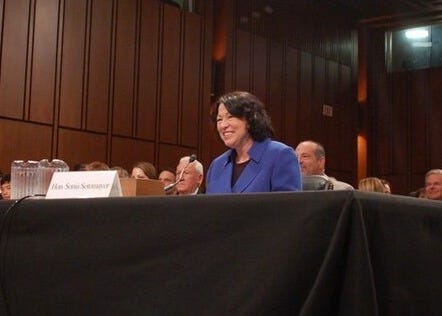
That was liberal law professor Louis Michael Seidman’s blunt condemnation of Sotomayor’s account of her judicial philosophy at her confirmation hearing. (Seidman was taking part in an online debate with me and others).
Let’s take a look here at how Sotomayor described her judicial philosophy. In my next post, I will ponder why.
***
When Barack Obama nominated Sonia Sotomayor to the Supreme Court, all the elements seemed to be in place for an exhilarating triumph for the Left:
A charismatic president who trumpeted the critical role of empathy in a judge’s determination of what the law means.
A “wise Latina” nominee with a genuinely inspiring life story and strong ties to the left-wing “public interest” community.
An overwhelming Democratic majority in the Senate.
A sympathetic media.
Progressives eagerly awaited Sotomayor’s robust presentation of their judicial vision. But that’s not at all what they ended up witnessing.
In her opening statement, Sotomayor defined her “judicial philosophy”: “The task of a judge is not to make law, it is to apply the law.” She repeated this mantra throughout the hearing:
“[J]udges must apply the law and not make the law.”
“[T]hat is my philosophy of judging, applying the law to the facts at hand.”
“The job of a judge is to apply the law…. The judge applies the law to the facts before that judge.”
“I apply the law to the facts before it [sic].”
“We cannot remedy the ills of society in a courtroom. We can only apply the law to the facts before us.”
“Judges apply the law, they apply the holdings of precedent, and they look at how that fits into the new facts before them. But you’re not creating law.”
More strikingly, Sotomayor emphatically repudiated the empathy standard that Obama committed to use in selecting his Supreme Court nominees:
Senator KYL: Do you agree with [Obama] that the law only takes you the first 25 miles of the marathon and that that last mile has to be decided what’s in the judge’s heart?
Judge SOTOMAYOR. No, sir. That’s—I don’t—wouldn’t approach the issue of judging in the way the President does. He has to explain what he meant by judging. I can only explain what I think judges should do, which is judges can’t rely on what’s in their heart. They don’t determine the law. Congress makes the laws. The job of a judge is to apply the law. And so it’s not the heart that compels conclusions in cases. It’s the law. The judge applies the law to the facts before that judge.
Sotomayor likewise rejected (or at least appeared to reject) the Left’s concept of a “living Constitution”:
Senator GRAHAM. Do you believe the Constitution is a living, breathing, evolving document?
Judge SOTOMAYOR. The Constitution is a document that is immutable to [sic] the sense that it’s lasted 200 years. The Constitution has not changed, except by amendment. It is a process—an amendment process that is set forth in the document. It doesn’t live, other than to be timeless by the expression of what it says. What changes, is society. What changes, is what facts a judge may get presented.
She instead seemed to argue that the original meaning of constitutional text ought to prevail over mistaken precedent:
Senator HATCH. Which is more important or deserves more weight? The actual wording of the Constitution as it was originally intended or newer legal precedent?
Judge SOTOMAYOR. The intent of the founders were set forth in the Constitution. They created the words, they created the document. It is their words that is the most important aspect of judging. You follow what they said in their words and you apply it to the facts you are looking at.
Sotomayor also rebuffed the invitations by multiple Democratic senators to slam the umpire simile that John Roberts had famously used in his confirmation hearing to convey the judicial duty of impartiality. She instead embraced the simile (while acknowledging the obvious fact that “analogies are always imperfect”):
What judges do, like umpires, is to be impartial and bring an open mind to every case before them.
***
I certainly don’t mean to suggest that anyone should have believed Sotomayor’s statements. As I wrote at the time (in the next round of that same online debate), Sotomayor “deserves an A+ for brazen doublespeak.” But the confirmation hearing was an excruciating fiasco for all the legal progressives, like Seidman, who were reasonably hoping and expecting that Sotomayor would provide an ardent defense of their constitutional vision.
As I will explore in my follow-on post, two larger (and interrelated) lessons emerge from this episode:
(1) By 2009, conservatives had resoundingly triumphed in the public rhetorical battle over the proper role of the courts.
(2) Even when confirmation is a virtual certainty, the White House and a Supreme Court nominee have a strong incentive to play it safe.
Your preoccupying obsession with Sotomayor seems weird and unhealthy.
Precedence should be abolished and never replace the law like it has done for decades