


On the same day that the New Republic’s Jeffrey Rosen published concerns from Democrats that Supreme Court candidate Sonia Sotomayor was “not that smart and kind of a bully on the bench” and “has an inflated opinion of herself,” the liberal academic superstar Laurence Tribe sent his protégé Barack Obama a private letter that made strikingly similar charges.
Tribe’s letter did not make waves during Sotomayor’s confirmation process for the simple reason that it did not become public knowledge until I received it and published it some 18 months later. But it provides interesting insight into the behind-the-scenes maneuvering that can take place as advocates of the competing contenders push their favorite.
***
Larry Tribe taught law at Harvard law school for more than 50 years, from 1968 until 2020. In his mid-30s, he wrote a magisterial treatise on constitutional law, American Constitutional Law. He argued frequently in the Supreme Court, and he was a close adviser to liberal senators on judicial confirmations and issues of constitutional law. His tenure included the six years (2003-2009) in which Elena Kagan was the law school’s dean, and he was surely deeply grateful to her for her controversial kid-gloves treatment of plagiarism charges against him.
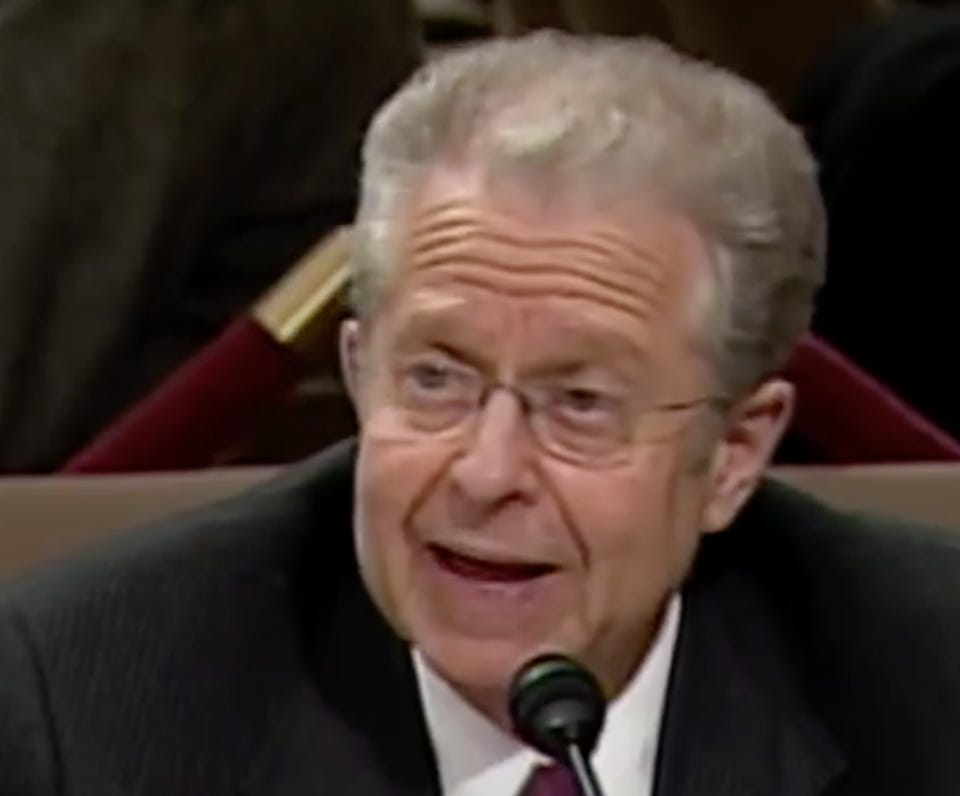
Barack Obama studied constitutional law with Tribe (as, to much lesser renown, did I), and worked for him as a research assistant. When Obama was running for president in 2008, Tribe hailed him as “the most impressive student I’d ever worked with.” Tribe and Obama remained close during Obama’s remarkable political ascent.
Tribe’s relationship with Obama enabled him to be very candid about how Obama should fill David Souter’s vacancy. Tribe began by emphasizing that it is “very important that you view the vacancy created by Justice Souter's resignation as an opportunity to lay the groundwork for a series of appointments that will gradually move the Court in a pragmatically progressive direction”:
Neither Steve Breyer nor Ruth Ginsburg has much of a purchase on Tony Kennedy's mind. David Souter did, and it will take a similarly precise intellect, wielded by someone with a similarly deep appreciation of history and a similarly broad command of legal doctrine, to prevent Kennedy from drifting in a direction that is both formalistic and right-leaning on matters of equal protection and personal liberty.
He then turned directly to the presumptive frontrunner Sonia Sotomayor and stated that he was “concerned that [her] impact within the Court would be negative in these respects”:
Bluntly put, she’s not nearly as smart as she seems to think she is, and her reputation for being something of a bully could well make her liberal impulses backfire and simply add to the fire power of the Roberts/Alito/Scalia/Thomas wing of the Court. [Emphasis added.]
Tribe then discussed possible candidates for a future Stevens vacancy and pointedly didn’t mention Sotomayor even for that vacancy.
As for the Souter seat:
I can't think of anyone nearly as strong as Elena Kagan, whose combination of intellectual brilliance and political skill would make her a ten-strike, if you’ll forgive my reference to bowling. I’ve known and worked with her ever since she was my student and research assistant in the 1980s, have watched her become a scholar of the first rank and a star as a teacher, and have marveled at how skillfully she transformed a school that had long been considerably less than the sum of its parts into a vibrant and wonderful place for students to learn and for faculty to teach, write, and collaborate. Her techniques for mastering the substance of the many fields in which we have made important new faculty appointments during her tenure as dean and for gently but firmly persuading a bunch of prima donnas to see things her way in case after case—techniques she has deployed with a light touch and with an open enough mind to permit others to persuade her from time to time—are precisely the same techniques I can readily envision her employing not just with justices like Kennedy but even with a justice like Alito or, on admittedly rare occasions, with a justice like Scalia or Roberts.
Tribe praised another contender, Seventh Circuit judge Diane Wood, as “more powerful intellectually than Sonia Sotomayor or any of the others mentioned as plausible prospects at the moment with the sole exception of Kagan, who is even smarter.” But he observed that Wood, who was ten years older than Kagan, “would be likely to serve nearly a decade less than Elena and doesn’t appear to me to have the dynamic personality or the extraordinary diplomatic gifts for inspiring confidence and for moving others that have made Elena Kagan the best dean of any major law school in memory.”
***
When Obama ended up not following Tribe’s advice, Tribe deftly finessed. Two days after Obama announced his selection of Sotomayor, a New York Times article addressed concerns that she “has a blunt and even testy side” that (at least “to detractors”) “raises questions about her judicial temperament and willingness to listen.” In giving the White House’s answers to those questions, Tribe left the impression that he had supported her selection:
Laurence H. Tribe, a Harvard law professor who served as an adviser in the process that led to Judge Sotomayor’s selection for the Supreme Court, said the White House had found concerns about her temperament unfounded, concluding instead that her background and her concern with the consequences of court rulings would be a “healthy antidote” to more formalist legal theories advocated by the Supreme Court’s conservative wing.
“The president’s inquiries into the way she interacts with others,” Professor Tribe said, “convinced him that she would be a positive force in the chemistry of the Supreme Court.”
It would seem that Tribe’s main role “as an adviser in the process that led to Judge Sotomayor’s selection” was to send his letter to Obama vigorously opposing her.
Tribe would go on to sign his name to a letter from more than one thousand law professors that described Sotomayor as a “brilliant, careful, fair-minded jurist” who was “an exceptionally well-qualified nominee to the Supreme Court.”
***
When I published Tribe’s letter in October 2010, I received a lot of inquiries about how I had obtained it. The short answer is that someone anonymously emailed it to me—or, more precisely, emailed it to someone else who emailed it to me. How that anonymous person obtained the letter is another matter.
It’s a very safe bet that Tribe contemporaneously sent a copy of his letter to Kagan in order to win credit for it. He probably sent it to other supporters of Kagan for the same reason. My guess—and it’s no more than that—is that my anonymous source obtained the letter downstream from one of the original recipients.
***
After I published Tribe’s letter, Tribe claimed that “the reservations I expressed about Justice Sotomayor prior to her nomination were amply refuted by the closer study I was able to give her record before the president made his decision.”
If that were true, Tribe would surely have raced to retract his advice to Obama, right? There is no evidence that he ever did.
Ok. Why is this relevant now?
Don’t agree with all her opinions. But compared to the conniving, dishonest Trumpstein wing of the Court she is a bulwark of sound jurisprudence.