


The time between a justice’s public decision to retire and a president’s announcement of his nominee to fill the Supreme Court vacancy is a perilous limbo. The weeks after Justice David Souter informed President Barack Obama that he intended to retire “[w]hen the Supreme Court rises for the summer recess this year” illustrate why.
***
The news that Justice Souter would retire leaked on April 30, 2009. The following day, May 1, Justice Souter sent his letter to President Obama.
Second Circuit judge Sonia Sotomayor, Seventh Circuit judge Diane Wood, and Solicitor General Elena Kagan quickly emerged as the top contenders for the nomination.
Sotomayor, then 54, had served on the Second Circuit since 1998. She had an inspiring life story and would be the first Hispanic justice ever (if you don’t count Benjamin Cardozo, a Sephardic Jew of Portuguese descent). She had been groomed for this possibility ever since Senator Daniel Patrick Moynihan of New York, as part of his power-sharing arrangement with his Republican colleague Al D’Amato, forced George H.W. Bush to appoint Sotomayor to a federal district court seat in 1992.
Wood, 58, was a liberal intellectual powerhouse on the Seventh Circuit, which she joined in 1995. She had clerked for Justice Harry Blackmun and before taking the bench had been a professor for over a dozen years at the University of Chicago law school, where Obama also taught.
Kagan, just turned 49, had been dean of Harvard law school before Obama selected her to be Solicitor General. She had been a law clerk for Justice Thurgood Marshall, taught at the University of Chicago law school, and worked in the Clinton White House.
***
When a nomination is up for grabs, the contenders will be tempted to advance their candidacies, especially if they can do so without leaving fingerprints. Their supporters, whether or not urged on by them, will also look for opportunities to do so. One way to promote a candidate ahead of her competitors is to tout her virtues. Another way is to highlight the shortcomings of her competitors.
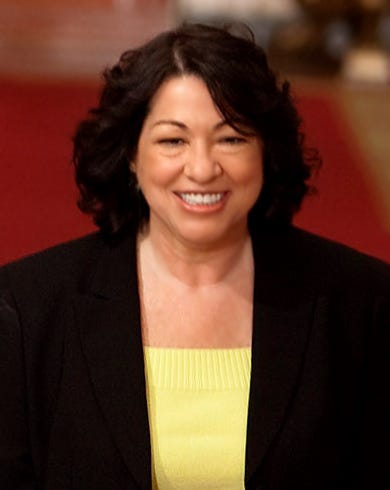
On May 4, just three days after Souter’s announcement, Jeffrey Rosen, the influential Supreme Court commentator at the then-influential New Republic, published a piece that the New Republic titled “The Case Against Sotomayor.” The essence of Rosen’s article was that Democrats who had worked with her and who wanted Obama “to appoint a judicial star of the highest intellectual caliber” believed that Sotomayor fell far short of the mark:
They expressed questions about her temperament, her judicial craftsmanship, and most of all, her ability to provide an intellectual counterweight to the conservative justices, as well as a clear liberal alternative.
The most consistent concern was that Sotomayor, although an able lawyer, was “not that smart and kind of a bully on the bench,” as one former Second Circuit clerk for another judge put it. “She has an inflated opinion of herself, and is domineering during oral arguments, but her questions aren’t penetrating and don’t get to the heart of the issue.”
Rosen’s piece ignited a firestorm of anger and infighting on the Left over the weeks that followed. How dare anyone suggest that Sotomayor wasn’t of the “highest intellectual caliber”? Who was feeding this line to Rosen? Who was behind it? What was Rosen’s own hidden agenda?
Kagan ran into different—gentler but still potent—concerns from the Left. As the New York Times reported, “a number of liberals say they are suspicious that she may lean too far toward the middle.”
***
The weeks of delay also enabled conservative critics to expose the records of the contenders. That was the mission I assigned myself. My goal wasn’t to favor one candidate over another. I aimed, rather, to continue to make the case for conservative judicial principles and to illustrate how far afield the contenders strayed from those principles. I hoped to raise the political costs to Obama of whomever he ended up picking.
I won’t burden you with an account of my many posts during this limbo period. I’ll simply observe that I and others succeeded in highlighting and stigmatizing Sotomayor’s “wise Latina” declaration—“I would hope that a wise Latina woman with the richness of her experience would more often than not reach a better conclusion than a white male who hasn’t lived that life”—in a way that I think framed the entire confirmation process.
***
The Obama White House had ample reason to anticipate that a Supreme Court justice would retire in 2009. John Paul Stevens was 89 years old, Ruth Bader Ginsburg was 76, and David Souter, though only 69, was known to hate living in Washington, D.C. and to relish returning to New Hampshire. But it wasn’t prepared to move quickly when Souter informed Obama of his retirement. Obama took a full 25 days before he announced that he would nominate Sotomayor.
Some time will be needed for review and deliberation. But there are always excuses for more dithering. A White House should recognize that delay has its downsides.
A year later, Obama would take 31 days to announce his nomination of Elena Kagan to John Paul Stevens’s seat. And most momentously, upon Justice Scalia’s death in February 2016, Obama would take 32 days to select Merrick Garland—enough time to enable Senate Republican opposition to filling the seat to set in concrete.
***
More broadly, there is an interesting partisan divide on how quickly presidents act: On the Democratic side, in addition to Obama: Bill Clinton took an excruciating 86 days to pick Ruth Bader Ginsburg and another 41 to pick Stephen Breyer. Joe Biden took 28 days to select Ketanji Brown Jackson. Across six nominations, that’s an average of 40 days.
On the Republican side:
Reagan took 19 days to pick O’Connor.
Thanks to Chief Justice Burger’s private advance notice of his intention to retire, Reagan was able to nominate William Rehnquist to Burger’s seat and Antonin Scalia’s to Rehnquist’s on the same day that Burger announced his retirement.
Reagan took 5 days for Bork.
George H.W. Bush took 3 days to announce Souter and 4 days to announce Clarence Thomas.
George W. Bush announced his first nomination of John Roberts 18 days after Sandra Day O’Connor declared her retirement.
And Donald Trump took 12 days to pick Brett Kavanaugh and 8 days to pick Amy Coney Barrett.
So even if you exclude the immediate Rehnquist and Scalia nominations, that’s an average of fewer than 10 days for a nomination by a Republican president. And the slowest nomination by a recent Republican president is faster than the fastest nomination by a recent Democratic president.
(I’ve excluded the selections of Douglas Ginsburg, Anthony Kennedy, Harriet Miers, Samuel Alito, and Neil Gorsuch on the ground that their situations aren’t comparable to first nominations. But I’m not slanting the data. If you want to include them: Reagan announced his intention to nominate Ginsburg 6 days after Bork’s nomination was defeated, and he announced the Kennedy nomination 4 days after Ginsburg withdrew. Bush 43 didn’t want to have two Supreme Court nominations pending at the same time, so he announced Miers 4 days after the Senate confirmed Roberts. He then announced Alito 4 days after Miers withdrew. Trump announced Gorsuch 11 days into his presidency. So these average fewer than 6 days.)
One possible, if partial, explanation for the disparity is that the vacancies during these Democratic presidencies all were announced or arose no later than the spring, so the president may not have felt any urgency in getting a justice in place for the Court’s next October term. By contrast, the vacancies during the Republican presidencies all arose after the Court had recessed for the summer, so a president couldn’t dillydally if he wanted his nominee to be hearing cases as soon as possible.