


[This is my third post in a series on John Adams’s appointment of John Marshall as Chief Justice. I invite you to read “The Kidney Stones that Made John Marshall Chief Justice” and “How a Vanishing Supreme Court Seat Led to John Marshall’s Appointment.”]
In his biography of John Marshall, Jean Edward Smith recounts the flurry of judicial commissions that John Adams issued just before handing over the presidency to Thomas Jefferson:
A week before Jefferson took office, the lame-duck Federalist Congress enacted legislation authorizing the president to appoint a number of justices of the peace in the nation’s capital. On March 2, 1801, two days before his term expired, President Adams nominated forty-two persons for that office. The nominees were duly confirmed by the Senate on March 3, shortly before adjournment. Adams immediately signed the commissions, and Marshall, as secretary of state, affixed the Great Seal of the United States. [Emphasis added.]
Smith here conveys the conventional account that Marshall continued “as secretary of state” after becoming Chief Justice in early February 1801. That account has deep roots: In his four-volume biography of Marshall published over a century ago, Albert Beveridge states that “Marshall was at the same time Chief Justice of the Supreme Court and Secretary of State” and that “Marshall, as Secretary of State, signed and sealed the commissions” that Adams issued on the eve of Jefferson’s inauguration.
But, as we shall see, this conventional account appears to be mistaken. Marshall, the evidence indicates, was not Secretary of State after he became Chief Justice. He no longer held the office of Secretary of State. Rather, he was merely performing the duties of the office. In today’s parlance, we would say that he was acting Secretary of State.
***
The very attentive reader of my last post (“How a Vanishing Supreme Court Seat Led to John Marshall’s Appointment”) might have noticed that in two neighboring sentences near the end I stated, seemingly verbosely, that Marshall “continued to perform the duties of the Secretary of State until Adams’s presidency ended on March 4” and that Marshall was “[p]erforming the duties of the Secretary of State” when he affixed the Great Seal to the commissions of the justices of the peace. I was in fact undertaking to be precise (and to incorporate what I had just learned from my longtime Bench Memos colleague Matthew Franck).
On the same day—February 4, 1801—that Marshall took the oath as Chief Justice, Adams wrote a letter to Marshall stating that he was “happy in your acceptance of the office of Chief Justice.” Adams further informed Marshall that the “Circumstances … of the times render it necessary that I should request and Authorise you, as I do by this Letter, to continue to discharge all the Duties of Secretary of State, untill ulteriour Arrangements can be made.” (All spelling oddities in original.)
Adams was evidently availing himself of the power granted by a statute enacted in 1795. That statute provided that “in case of vacancy in the office of Secretary of State [or various other offices], … it shall be lawful for the President … to authorize any person or persons, at his discretion, to perform the duties of the said respective offices, until a successor be appointed” (but not “for a longer term than six months”). It was, in short, a precursor to the Federal Vacancies Reform Act of 1998 that is now in effect and to that Act’s conferral of power to create what we now call “acting” officers.
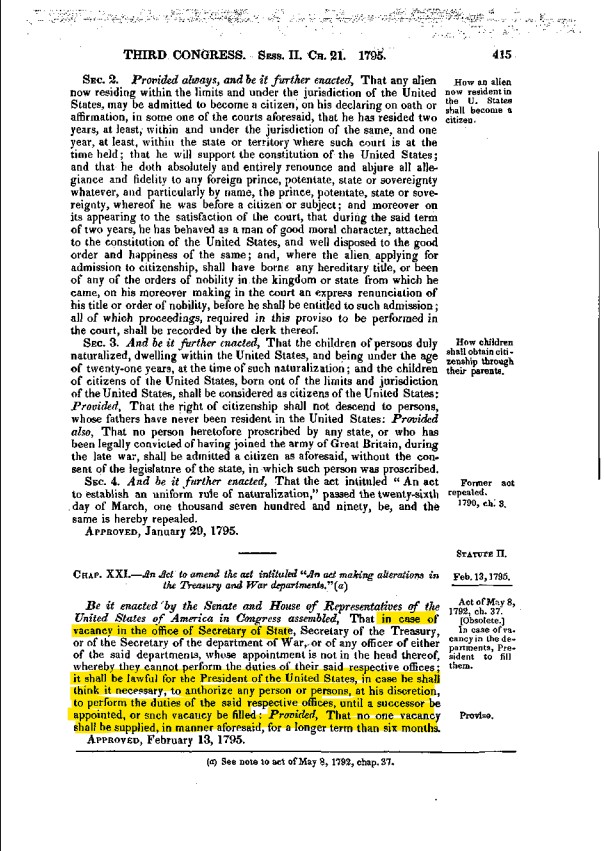
One piece of evidence that Adams was invoking his power under the 1795 statute is that Adams seemed to regard it as necessary to “Authorise” Marshall “to continue to discharge all the Duties of Secretary of State.” Indeed, he specified that “I do [so] by this Letter.” But if Adams wanted Marshall simply to remain as Secretary of State (and if he believed that it was constitutionally permissible for Marshall to do so), there would have been no need for Adams to provide Marshall a formal new authorization.
***
Marshall also appears to have clearly understood that, after he became Chief Justice, he was performing the duties of Secretary of State pursuant to the 1795 statute (as acting Secretary, as we would now say). I draw here on an intriguing exchange of letters between Jefferson and Marshall right before Jefferson’s inauguration on March 4, 1801.
In a letter to Marshall on March 2, Jefferson explained that he had been requested “to sign some sea letters to be dated on or after the 4th. of Mar.” (From what I can gather, signed but otherwise blank sea letters were sent to customs collectors, who would issue them to shipmasters to establish proof of their nationality and to guarantee protection of their vessels.) The sea letters, in addition to being signed by Jefferson, needed a second qualified signature (i.e., needed to be countersigned). Jefferson wanted Marshall to sign them but had learned that Marshall saw a procedural wrinkle that needed to be ironed out:
I understood you would countersign them as the person appointed to perform the duties of Secretary of state, but that you thought a reappointment to be dated the 4th. of March would be necessary.
Marshall responded the same day:
Not being the Secretary of State, & only performing the duties of that office at the request of the President, the request becomes indispensably necessary to give validity to any act which purports to be done on the 4th. of March.
In other words, Jefferson understood, and Marshall clearly confirmed, that Marshall did not view himself to be Secretary of State. If he were Secretary of State, he would automatically continue in that office into Jefferson’s presidency, and Jefferson would not need to take any action to appoint him. Marshall obviously believed that his service as acting Secretary pursuant to the 1795 statute would terminate when Adams’s presidency ended. It’s not at all clear to me that he was right, but that’s the only reason that he would think that his “reappointment” pursuant to the same statute was “indispensably necessary” for him to countersign the sea letters.
In a letter dated March 4, 1801, Jefferson provided Marshall the reauthorization he requested and invoked the 1795 statute:
In pursuance of the act of Congress providing that in case of vacancy in the office of Secretary of state the President of the US. may authorize a person to perform the duties of the same, I am to ask the favor of you, & hereby authorize you to perform the duties of the Secretary of state until a successor to that office shall be appointed.
In his own letter dated March 4, Marshall promptly accepted Jefferson’s reauthorization:
I have receiv[e]d your letter requesting me to perform the duties of Secretary of State until a successor be appointed. I shall with great pleasure obey this request…
Marshall’s service as Jefferson’s acting Secretary of State lasted one day. On March 5, Jefferson authorized Levi Lincoln to play that role.
***
Marshall’s insistence that it was “indispensably necessary” for Jefferson to authorize him to countersign the sign letters is especially curious in that Marshall was accommodating Jefferson’s desire to issue the sea letters before Jefferson in fact became president—before, in other words, he actually had the authority to issue the sea letters. Jefferson issued the sea letters before his inauguration and postdated them to give the false appearance that he had issued them as president. Jefferson spelled this plan out plainly for Marshall in his March 2 letter:
I was desired two or three days ago to sign some sea letters to be dated on or after the 4th. of Mar. but in the mean time to be forwarded to the different ports.
Marshall fully understood and did his part. Note that in his March 2 letter responding to Jefferson he stated that the authorization that he requested is “indispensably necessary to give validity to any act which purports to be done on the 4th. of March.” Any doubt what he meant by “purports” is eliminated by his next sentence: “In the confidence” that Jefferson would make the authorization, Marshall committed to “immediately proceed to sign the sea letters”—that is, before Jefferson had become president.
What’s more, Jefferson post-dated his March 4 letter to Marshall, and Marshall did the same—or, rather, tried to—with his March 4 response. Jefferson’s meticulous record of his correspondence shows that he received Marshall’s response on March 3, so he must have sent his supposed March 4 letter no later than March 3. (See annotation here.) So Jefferson did not yet have the power to authorize Marshall to perform the duties of Secretary of State.
So while Marshall was administering the presidential oath to Thomas Jefferson on March 4, sea letters that Jefferson had purported to sign as president and that Marshall had purported to confirm by his own signature were on their way to customs collectors along the Atlantic coast.
***
Another curious aspect is that instead of postdating his response, as he obviously intended to do, Marshall actually dated his letter March 4, 1781—twenty years earlier! (I wonder if Jefferson noticed.) That should provide some comfort to those of us who put the previous year’s date on letters we write well into January.
***
Marshall’s performance of the duties of Secretary of State in the month following his appointment as Chief Justice has engendered at least two sets of controversies:
(1) Under a sound understanding of constitutional separation-of-powers principles, was it proper for Marshall, once he became Chief Justice, to continue to serve in the Adams administration?
(2) Given Marshall’s role in sealing Marbury’s commission and directing that it be delivered to him, should Marshall have recused himself from participating in the decision in Marbury v. Madison?
I’m not going to offer my two cents’ worth on these questions here. I will instead simply note that I doubt very much that the answers to these questions are affected by whether Marshall continued as Secretary of State (the conventional assumption) or was instead performing the powers of the office pursuant to the 1795 statute (as acting Secretary).
***
As fastidious as Marshall was to inform Jefferson that he wasn’t actually Secretary of State (“Not being the Secretary of State, & only performing the duties of that office at the request of the President…”), it’s amusing to see that he overlooked the distinction two years later in his opinion in Marbury v. Madison. In the two instances in which Marshall cites his own actions in sealing Adams’s commissions, he refers to himself as “the Secretary of State”:
Mr. Marbury, then, since his commission was signed by the President and sealed by the Secretary of State, was appointed, and as the law creating the office gave the officer a right to hold for five years independent of the Executive, the appointment was not revocable, but vested in the officer legal rights which are protected by the laws of his country.
It is then the opinion of the Court … [t]hat, by signing the commission of Mr. Marbury, the President of the United States appointed him a justice of peace for the County of Washington in the District of Columbia, and that the seal of the United States, affixed thereto by the Secretary of State, is conclusive testimony of the verity of the signature, and of the completion of the appointment, and that the appointment conferred on him a legal right to the office for the space of five years.
One can sympathize, I suppose, with Marshall’s decision not to write “by the person performing the duties of the Secretary of State,” as that circumlocution might have drawn more attention than he wanted to the fact that he was that person.
***
Some puzzles remain. Although Marshall and Jefferson were second cousins (once removed), they disliked and distrusted each other. Why would Jefferson expect Marshall to go along with his irregular scheme? Why did Marshall do so? Why didn’t whoever “desired” Jefferson to issue the sea letters go to Adams instead?
With the large caveat that I’m no historian and haven’t taken a deep dive into histories of the period, let me hazard a guess:
The Convention of 1800 that Chief Justice Oliver Ellsworth negotiated on behalf of the Adams administration brought an end to the Quasi-War with France and opened up trade with both France and Britain. As Marshall knew, Jefferson was a strong supporter of the Convention of 1800. Marshall would have been eager to help Jefferson revive trans-Atlantic shipping, and he would have seen that revival as a vindication of Adams’s policy. Adams, meanwhile, was very busy in his last days as president finalizing his judicial appointments. It’s easy to imagine that he wouldn’t want to be bothered with sea letters. Given how close Adams and Marshall were, they probably agreed that Marshall could cooperate with Jefferson.
***
In fairness to Jean Edward Smith, I must note that some twenty pages before stating that “Marshall, as secretary of state, affixed the Great Seal of the United States” to the commissions, Smith accurately describes the February 4 exchange of letters between Adams and Marshall. But he confusedly states that a memorandum that Marshall wrote “at the end of February” “ended Marshall’s tenure as secretary of state.” He seems in this passage to somehow be forgetting about the March commissions, and he doesn’t recognize that the February 4 letters show that Marshall’s acceptance of his judicial commission terminated his position as Secretary of State.
Beveridge similarly quotes the February 4 letters but doesn’t grasp their meaning. He even insists that Marshall “would have been entirely justified” in drawing “both salaries” for Chief Justice and Secretary of State.
The Office of the Historian at the Department of State, I’m pleased to see, accurately states that Marshall’s appointment as Secretary of State terminated on February 4, and it says that he was “Acting as Secretary of State” from February 4 through March 4. (I wish that it did not use the term “Secretary of State ad interim” as a synonym for “Acting as Secretary of State.”)
I think the phrase “ad interim” is diplomatic parlance and would come naturally to the historian at State?