


It’s easy in hindsight to think that some individuals were destined to become Supreme Court justices. But there is no such thing as an inevitable justice. Every justice’s path to the Supreme Court involves happenstance.
John Marshall’s tenure as Chief Justice was so foundational to the role of the Supreme Court in the American system of government that it’s easy to overlook the remarkable serendipities that made it possible. I’ll address three of them here: Oliver Ellsworth’s kidney stones, John Jay’s rejection of his commission, and Timothy Pickering’s sabotage of Adams.
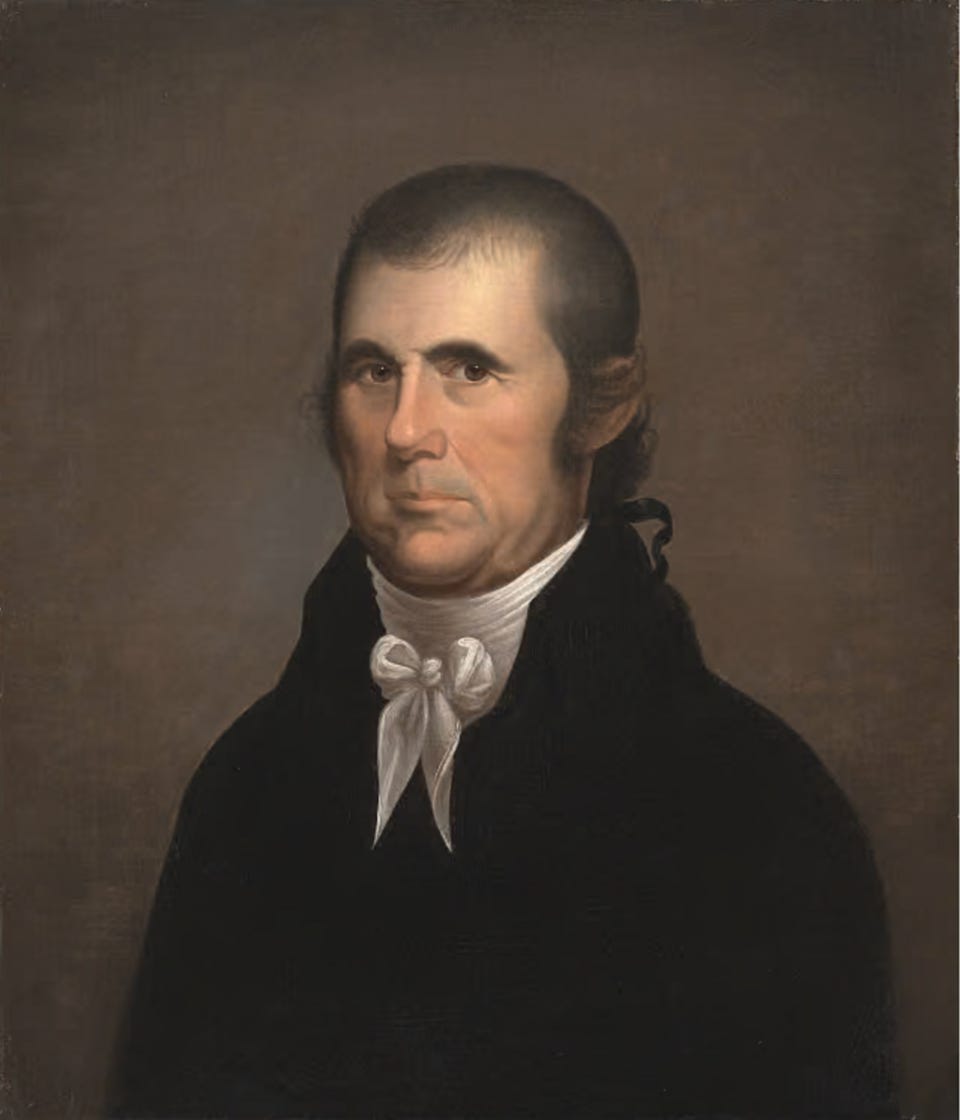
I draw here from three scholarly articles—Kathryn Turner’s “The Appointment of Chief Justice Marshall” (1960), R.B. Bernstein’s “President John Adams and Four Chief Justices” (2013), and Lindsay Chervinsky’s “John Adams’s Most Important Presidential Precedent” (2021)—from Jean Edward Smith’s 1996 biography of John Marshall, and from various public sources.
***
In 1796, George Washington appointed Oliver Ellsworth as Chief Justice. In 1799, John Adams selected Ellsworth to be part of a delegation to France to resolve the so-called Quasi-War. Ellsworth, still in his position as Chief Justice, left for France in November 1799 and, after an arduous voyage, arrived four months later. In September 1800, he consummated a peace agreement with Napoleon.
Ellsworth’s health, however, continued to suffer from his voyage to France. In a letter to Adams dated October 16, 1800, Ellsworth informed Adams that “the unfortunate fruit of sufferings at sea” was that he was “[c]onstantly afflicted with the gravel”—what we today call kidney stones—“and the gout in my kidnies [sic]” and was therefore “not in a condition to undertake a voyage to America at this late season of the year.” Indeed, even if he were already back in the United States, his poor health meant that he would not “be able to discharge my official duties” as Chief Justice. He therefore resigned his position.
Adams did not receive Ellsworth’s letter until December 15, 1800. The very next day, he learned that he had lost his bid for re-election and that his youngest son Charles had died of complications from alcoholism.
It wasn’t yet clear who would win the electoral-college tie between Thomas Jefferson and his supposed vice-presidential candidate Aaron Burr. But Adams knew that his presidency would end on March 4, 1801.
***
Adams immediately decided that John Jay should replace Ellsworth as Chief Justice. Jay had been the Court’s first Chief Justice, appointed by Washington in 1789. But Jay had resigned the position in 1795, at the age of 49, largely because he detested the “onerous and sometimes potentially life-threatening” duty (Bernstein) of justices to “ride circuit”—to travel around the country to preside over regional circuit courts.
Jay was elected governor of New York in 1795. He was re-elected in 1798, and his three-year term would expire in mid-1801.
Adams hoped that pending legislation to abolish circuit-riding would make Jay willing to serve again as Chief Justice. Without consulting Jay, Adams nominated him on December 18. The Senate confirmed the nomination the very next day, December 19. That same day, Adams issued Jay’s commission and sent him a letter exhorting him to accept the appointment:
In the future Administration of our Country the firmest Security We can have against the Effects of visionary Schemes or fluctuating Theories, will be in a solid Judiciary: and nothing will cheer the hopes of the best Men so much as your Acceptance of this appointment. You have now a great Opportunity to render a most signal service to your Country. I therefore pray you most earnestly to consider of it, seriously and accept it.
I had no permission from you to take this Step, but it appeared to me that Providence had thrown in my Way an Opportunity not only of marking to the publick, the Spot where, in my Opinion the greatest Mass of Worth remained collected in one Individual but of furnishing my Country with the best Security, its inhabitants afforded, against the increasing dissolution of Morals.
A month later, in mid-January 1801, Adams received Jay’s letter (dated January 2) rejecting the appointment and explaining why. The duty of circuit-riding appears to have been the driving factor, though Jay’s language was indirect.
Jay complained that the 1789 Act that established the judiciary “was in some Respects more accommodated to certain Prejudices and Sensibilities, than to the great and obvious Principles of sound Policy” and that repeated efforts to fix the problem “have proved fruitless.” As Stuart Banner details in his outstanding history of the Supreme Court, from the very beginning the justices “persistently lobbied the other two branches of government …. pleading to be relieved from their circuit[-riding] obligations.” Jay explained that he resigned as Chief Justice in 1795 “perfectly convinced that under a System so defective, [the Supreme Court] would not obtain the Energy weight and Dignity which are essential to its affording due support to the national Governm[en]t.”
Having “carefully considered what is my Duty, and ought to be my conduct on this unexpected and interesting occasion,” Jay told Adams that “the State of my Health removes every Doubt” about whether he should accept the appointment. Here again, his underlying complaint is evidently about circuit-riding, as he observes that the state of his health is “clearly and decidedly incompetent to the Fatigues incident to the office.”
***
Timothy Pickering became Secretary of State under George Washington in 1795. When Adams became president in 1797, he decided to retain Pickering as well as Washington’s Secretary of War James McHenry and Secretary of Treasury Oliver Wolcott Jr., even though all three were loyal to Alexander Hamilton rather than Adams. In the words of one presidential historian, “Over the next few years, they tried to sabotage Adams’s foreign policy, thwarted his efforts to keep the country out of war, and undermined his reelection campaign.” According to the custodian of his papers, Pickering sought war with France, tried to block two of Adams’s nominations, and “secretly conferred with Alexander Hamilton and other leading Federalists, reporting to them what went on in cabinet meetings with the president.”
By May 1800, Adams had finally had enough of McHenry and Pickering. He forced McHenry to resign and nominated Marshall as his new Secretary of War. The Senate promptly confirmed the nomination, but Marshall, “not believ[ing] myself well qualified for this department,” rejected the appointment.
Adams then invited Pickering to resign. Pickering replied that he preferred to remain in office. Adams then fired him. Adams nominated Marshall as Secretary of State, the Senate confirmed the nomination, and this time Marshall accepted it.
John Marshall became Secretary of State on June 13, 1800, and over the next seven months built a strong relationship of trust with Adams.
***
Years later, Marshall provided an account of what happened on January 19, 1801, when Adams read John Jay’s letter declining his appointment as Chief Justice. Adams asked Marshall, “Whom should I nominate now?” Marshall suggested that Adams elevate Associate Justice William Paterson. Adams rejected the suggestion “in a decided tone.” Marshall’s account continues:
After a moment’s hesitation he [Adams] said, “I believe I must nominate you.” I had never before heard myself named for the office and had not even thought of it. I was pleased as well as surprised, and bowed in silence. Next day I was nominated.
***
If Oliver Ellsworth hadn’t developed kidney stones (probably because of dehydration) on his voyage to France, he would have continued as Chief Justice into Jefferson’s presidency, and Jefferson would have named his successor. (Or perhaps Madison or Monroe would have. Ellsworth died during Jefferson’s second term, but he is said never to have fully recovered from his France trip, so if he hadn’t gotten so ill, he might have lived longer.) Would a Chief Justice selected by Jefferson have charted a course for the nation remotely like Marshall’s? That is very unlikely.
If Congress had abolished circuit-riding by 1800, John Jay might well have accepted Adams’s appointment as Chief Justice. Perhaps Jay, who lived until 1829 (six years shy of Marshall), would have established himself as the central figure in American constitutional history. Perhaps not.
If Pickering had been loyal to Adams, would Marshall have had the opportunity to earn Adams’s deep trust? It’s difficult to see how. Plus, Marshall had already declined Adams’s offer to appoint him as an Associate Justice in 1798. Why, but for Marshall’s valuable service as Secretary of State, would Adams turn to him for a more exalted position?