


In “The Kidney Stones that Made John Marshall Chief Justice,” I discussed three fortuitous events that led to John Adams’s decision to nominate John Marshall as Chief Justice. Another factor that played an intriguing role was a provision of the bill pending in Congress that would become the Judiciary Act of 1801. That provision—section 3 of the Act—would reduce the number of Supreme Court justices from six to five.
Two of the scholars whose work I drew on in my previous post—historian Kathryn Turner and Marshall biographer Jean Edward Smith—have offered competing accounts of how section 3 affected Adams’s thinking. Disagreeing with both, I’ll advance my own theory.
***
John Adams signed into law the Judiciary Act of 1801 (also known as the Midnight Judges Act) on February 13, 1801, nineteen days before his single term as president ended. Among its many provisions, the Act ended the justices’ circuit-riding duties and created instead sixteen circuit judgeships across the six judicial circuits.
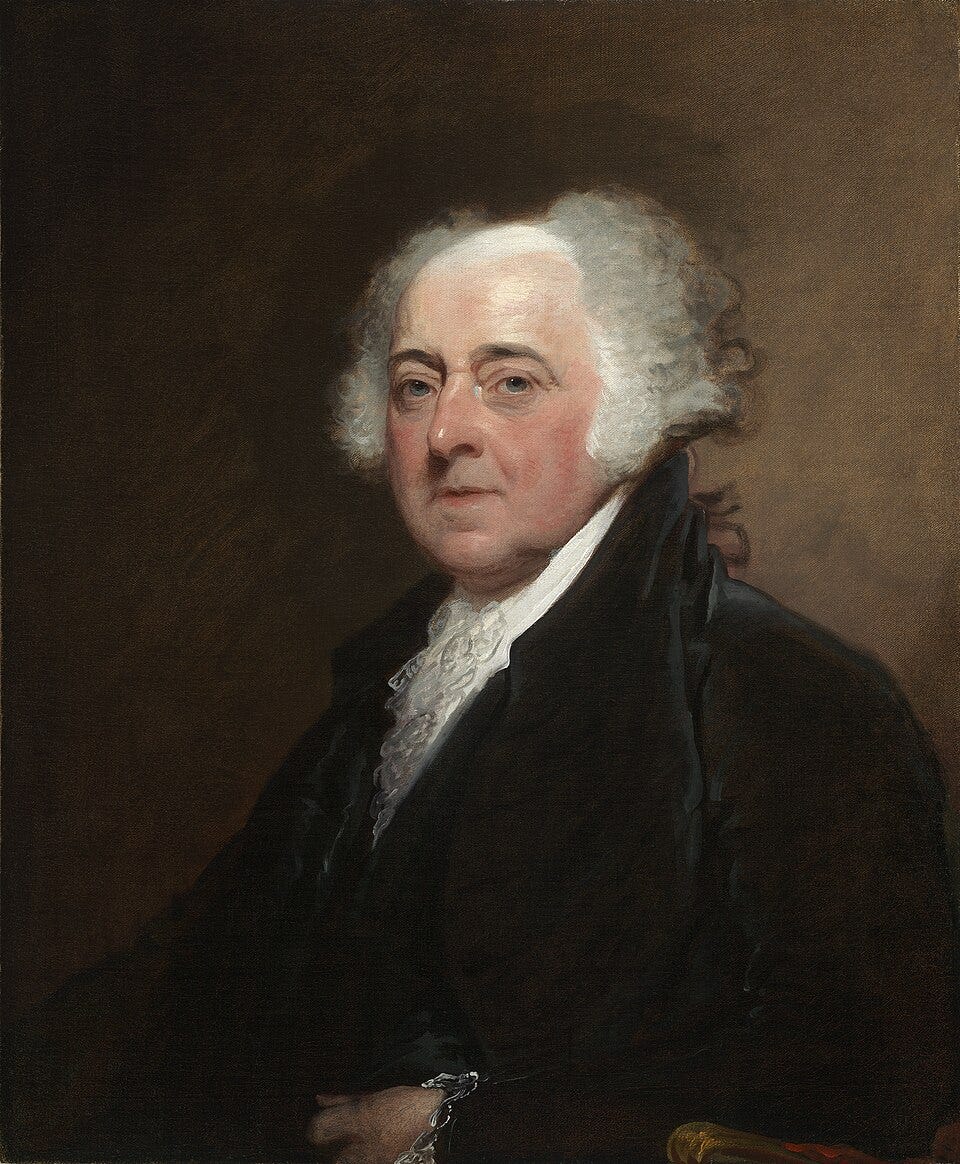
Because it was no longer necessary to have a justice for each circuit, Congress was able to eliminate the awkward possibility that a Court of six justices would generate tie votes. And because a huge burden of work would be lifted from the justices, the Act reduced the number of justices to five (rather than, say, increasing it to seven). Specifically, section 3 of the Act stated:
That from and after the next vacancy that shall happen in the said court [the Supreme Court], it shall consist of five justices only; that is to say, of one chief justice, and four associate justices.
The Judiciary Act of 1801 is often regarded as the Federalist Party’s intensely partisan response to its defeats, in the presidency and in Congress, in the 1800 elections. But as Turner argues (in “Federalist Policy and the Judiciary Act of 1801”), its bolstering of federal judicial power should be understood more broadly as an “integral part of [longstanding] Federalist policy.” The Federalists had introduced very similar legislation in March 1800 (and Marshall, as a House member, had been appointed to the committee to review it). To be sure, as Turner acknowledges, the political defeats in November 1800 “gave a driving urgency to the fight for … passage” of the Act. Her larger point is that the Act “was not conceived in the exigencies of defeat to compensate for that catastrophe.”
***
In order to try to make sense of the role that section 3 played in Adams’s selection of Marshall, here is a chronology of relevant events:
December 15, 1800: Adams learns of Oliver Ellsworth’s resignation as Chief Justice.
December 18: Adams nominates John Jay as Chief Justice.
December 19:
The Senate confirms Jay’s nomination, and Adams issues Jay’s commission.
The bill that will become the Judiciary Act of 1801 is introduced in the House. (According to one scholar, no copy of the bill as introduced exists, but “we do know that it had the same number of sections and was spoken of by members as being substantially unaltered from” the March 1800 bill. For our purposes, that would mean that it contained something very much like section 3.)
January 12, 1801: The House (more precisely, the Committee of the Whole) makes some amendments to the Judiciary Act bill and tees it up for a floor vote. (Section 3 was surely in final form by this point.)
January 19, 1801: Adams receives Jay’s letter declining his appointment. Adams informs Marshall that he will nominate him as Chief Justice.
January 20:
Adams nominates Marshall as Chief Justice.
The House passes the Judiciary Act bill and sends it to the Senate.
January 27: The Senate confirms Marshall’s nomination as Chief Justice.
January 29: The Senate committee to which the Judiciary Act bill had been referred reports it, without any amendments, to the Senate floor.
February 7: The Senate passes the Judiciary Act bill (without any amendments).
February 13: Adams signs into law the Judiciary Act of 1801.
***
Now let’s look at Turner’s account of the role that section 3 played in Adams’s decision to nominate Marshall.
Turner makes much of a note that Benjamin Stoddert, the Secretary of the Navy, sent to Adams on January 19. In his note, Stoddert informs Adams that “some members of Congress” have requested him to relay word that “the Judiciary bill would be taken up in the House of Representatives tomorrow—& be passed upon.” Further:
As the bill proposes a reduction of the Judges to five—and as there are already five Judges in commission, it is suggested that there might be more difficulty in appointing a chief Justice without taking him from the present Judges, after the passage of this bill even by one Branch of the Legislature, than before. [Turner’s italics.]
In the event that Jay declined his commission, Adams had initially wanted to elevate one of the associate justices to the position of Chief Justice and to nominate Philadelphia lawyer Jared Ingersoll as associate justice. But Ingersoll had indicated that he wouldn’t accept an appointment unless it was certain that the bill eliminating the justices’ circuit-riding duties would be enacted.
Turner concludes:
The sequence of this combination of circumstances makes clear that the action of the House of Representatives on the judiciary bill had direct bearing on the appointment which the President did make to the vacant seat on the bench. It also clarifies the reason why John Adams failed to follow his plan of selecting the chief justice from the membership of the Court. Indeed, it seems likely that it was the timing of the House action alone which forced him at this point to select a figure from outside the Court as the new chief justice. [Turner’s italics.]
I confess that I find it puzzling that the House members whose message Stoddert was transmitting would think that the mere passage of the Act by the House would make it more difficult for Adams to elevate a sitting justice to Chief Justice. Why would it be politically more palatable for Adams to make such a selection right before the House passed the Act but not a few days after? Why would Turner think that the prospect of the House vote on January 20 “forced” Adams “to select a figure from outside the Court as the new chief justice”?
I see an answer to the puzzle, but it’s not one that Turner provides. It’s legal, not political.
If Adams elevated a sitting justice to Chief Justice, the resulting vacancy in the associate-justice position would arise only once Adams appointed that person as Chief Justice. If section 3 became law in the meantime,* then the newly vacated associate-justice seat would be abolished, so Adams would not be able to appoint anyone to that seat. The Court would be reduced to five justices.
By picking someone from outside the Court, Adams would be adding a sixth Federalist justice. Marshall would be the second youngest member of the Court and have the prospect of a long tenure as Chief Justice. What’s more, section 3 would likely operate to the detriment of Adams’s Democratic-Republican successor (it wasn’t yet clear whether that would be Thomas Jefferson or Aaron Burr), as the first seat that became vacant during his presidency would disappear.
One objection to my answer is that Adams and the Federalists who controlled Congress should have been able to coordinate things so that the Judiciary Act of 1801 became law (or section 3 became effective) only after Adams elevated a sitting justice and filled the seat vacated by that justice. But Adams had very contentious relations with Federalists in Congress—Turner recounts that “the Senate delayed in approving Marshall’s nomination while Federalist leaders tried unsuccessfully to persuade Adams to choose [Justice William] Paterson instead”—so he might reasonably have decided to play it safe.
***
I first went down this rabbit hole when I read this passage (p. 14) in Smith’s biography of Marshall about the Judiciary Act of 1801 and section 3:
If Adams delayed naming a replacement until the bill was passed, Ellsworth’s resignation in itself would reduce the size of the Court, and the incoming Republican president would name the next chief justice. That left Adams almost no time to find a replacement.
I don’t think that Smith is correct that “Ellsworth’s resignation in itself would reduce the size of the Court.” Section 3 (which Smith doesn’t quote) applies to “the next vacancy that shall happen.” Ellsworth’s vacancy had already happened** when the Federalists re-introduced their judicial-reform legislation on December 19, 1800. (Jay’s rejection of his commission left the vacancy unfilled; it did not create a new vacancy, and even on the misunderstanding that it did, Jay’s rejection obviously took place before Adams made another nomination.)
***
John Marshall began his 34-year tenure as Chief Justice on February 4, 1801. At Adams’s request, he continued to perform the duties of the Secretary of State until Adams’s presidency ended on March 4.
On February 27, Congress enacted the District of Columbia Organic Act of 1801, which (among other things) created positions of justice of the peace in D.C. Performing the duties of the Secretary of State, Marshall affixed the Great Seal of the United States to the commissions that Adams issued for these positions and directed his younger brother James to deliver them. James’s failure to deliver William Marbury’s commission to him would of course give rise to Marshall’s landmark ruling in Marbury v. Madison in 1803.
In early 1802, the new Democratic-Republican majority in Congress repealed the Judiciary Act of 1801, so section 3 never operated—beyond whatever effect it had on Adams’s selection of Marshall.
* One might also argue that if the newly vacated associate-justice seat hadn’t been filled by the time section 3 became law, the vacancy would be deemed to “happen” after enactment. That might well strike you as ludicrous, but a five-justice majority in NLRB v. Noel Canning (2014) ruled that vacancies “happen” for purposes of the Recess Appointments Clause both when they “first come into existence during a recess” and when they “arise prior to a recess but continue to exist during the recess.” As Justice Scalia notes in his separate opinion disagreeing with the majority on this point, Adams’s Attorney General Charles Lee rejected that interpretation (even though it would have benefited Adams). It seems highly unlikely that Lee would have had a different reading of “happen” in section 3, especially as the full phrase “the next vacancy that shall happen” would seem to further preclude the possibility that an already-existing vacancy can trigger section 3.
** See previous footnote regarding possible contrary claim.