


As I have done for Bill Clinton and George W. Bush, I am going to begin my exploration of judicial-confirmation battles during Barack Obama’s presidency by a series of posts that take a deep dive into his Supreme Court nominations. But before we get into the details, let’s look at the big picture.
The broad narrative of Obama’s two Supreme Court nominations is in many respects strikingly similar to that of Clinton’s two Supreme Court nominations sixteen years earlier. But there is one stark difference: Obama’s nominees encountered significant opposition from Republican senators.
Clinton’s nominees, Ruth Bader Ginsburg and Stephen Breyer, together received a grand total of 12 votes against their nominations (3 against Ginsburg, 9 against Breyer). Obama’s nominees, Sonia Sotomayor and Elena Kagan, had a total of 68 votes cast against them (31 against Sotomayor, 38 against Kagan).
Let’s look at the general reasons why.
* * *
There are many parallels between Bill Clinton and Barack Obama when it comes to Supreme Court nominations.
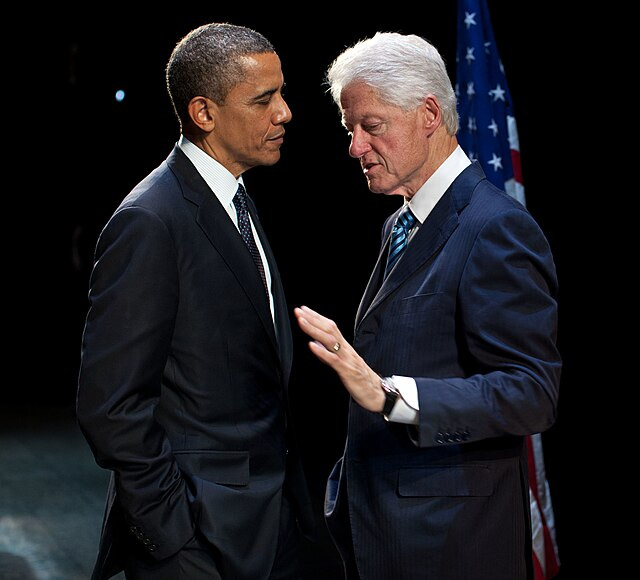
Both Clinton and Obama were lawyers who had a deep interest in the Supreme Court and who had indeed taught constitutional law—Clinton at the University of Arkansas, Obama at the University of Chicago. Each was married to a liberal lawyer whom he had met in law school—Clinton at Yale, Obama at Harvard. Each, when he became president, was young—Clinton was 46, Obama was 47—and each was regarded as charismatic and rhetorically adept.
Both Clinton and Obama had the gift of two Supreme Court vacancies in their first two springs in office. Both enjoyed a large Democratic majority in the Senate during those years: Democrats had 57 senators in 1993 and 1994, and they had 58 to 60 senators in 2009 and 2010 (including two independents who were part of the Democratic caucus). So both had a safe path to confirmation for their Supreme Court nominees.
Clinton and Obama voiced similar visions of what they were looking for in a Supreme Court justice. Clinton wanted “someone with a big heart,” someone “of genuine stature and largeness of ability and spirit.” Obama likewise asserted that what really matters in difficult cases is “what is in the justice’s heart,” “their broader vision of what America should be.”
Each was particularly insistent on the issue of abortion. When Clinton ran for president in 1992, he repeatedly promised that his Supreme Court nominees would be “strong supporters of Roe v. Wade.” In his campaign, Obama promised to “make preserving women’s rights under Roe v. Wade a priority as president.”
* * *
You would have to struggle very hard to make the case that Ruth Bader Ginsburg and Stephen Breyer deserved far more support from Republican senators than Sonia Sotomayor and Elena Kagan did. The reality is that the politics of the Supreme Court confirmation process changed dramatically in the 16 years between the two pairs of nominations.
At the outset of the Clinton administration, Republican senators continued to cling to the “deference” approach to Supreme Court nominations. Under the deference approach, senators deciding whether to support or oppose a nominee should ignore or demote considerations of judicial philosophy and focus primarily on whether the nominee meets some suitable standard of intellect, character, and experience. Senate Democrats had already abandoned that approach, first in their defeat of Robert Bork’s nomination in 1987 and then in their opposition to Clarence Thomas’s nomination in 1991. So, as I’ve spelled out, the best explanation of why Republican senators continued to invoke deference is that they believed it made their path to re-election easier: they were hoping that their conservative base wouldn’t punish them for supporting a liberal nominee, and they were winning credit with moderates.
The deference approach was unsustainable after Senate Democrats fought, and voted in large numbers against, George W. Bush’s nominations of John Roberts and Samuel Alito. The conservative base of the Republican party had mobilized in support of those nominations and against Democrats’ unprecedented campaign of partisan filibusters against Bush’s appellate nominees. Judicial confirmations had become a high-profile, hot-button political issue. Advances in communications technology meant that Republican senators could no longer treat a Supreme Court nomination as an inside game. Many Republican senators now had to worry that they would invite a primary challenge if they did not stand strong against liberal nominees.
* * *
It is doubtful that any Democratic president could have lowered the temperature on judicial confirmations. But Obama surely couldn’t. He had helped to escalate the confirmation wars during his short stint as a senator. In explaining his vote against John Roberts in 2005, he had articulated his notorious “empathy” standard for judging. He not only voted against Alito’s nomination; he even joined the effort to filibuster it. And he dragged the judicial-confirmation process for lower-court nominees to a new low when he became the first senator to embrace the Left’s scurrilous and racially charged attack on Fifth Circuit pick Leslie Southwick in 2007.
"You would have to struggle very hard to make the case that Ruth Bader Ginsburg and Stephen Breyer deserved more support from Republican senators than Sonia Sotomayor and Elena Kagan did. "
This seems pretty unfair to Stephen Breyer. Breyer was generally more conservative (as a policy matter) than Kagan and Sotomayor on Fourth Amendment issues, Free Exercise, and Establishment Clause cases. He was also very important in moving antitrust law in a sensible direction and upping threshold to survive a 12(b)(6) motion.
Michael McConnell wrote in 1988 that Michael Dukakis, if elected, should Breyer him on the Court in his WSJ Article "We Need Justices Who Mean Business
A good choice for President Dukakis: Stephen Breyer."
https://www.wsj.com/articles/SB989468486760000561?gaa_at=eafs&gaa_n=AWEtsqeFPix2l2U635wsNSTJLwT8k_LP5Pvklv9vIYqzRg8Hk7Q0zvrQUcBujV2kLg8%3D&gaa_ts=698df306&gaa_sig=0VFgXN6NuxSmc1bP012An3_tWx071RIFkcDy2SBpq-iUVBx0nHoAqFnAGEWJpNlDZFDMisWXTfh648e2vdyHVQ%3D%3D