


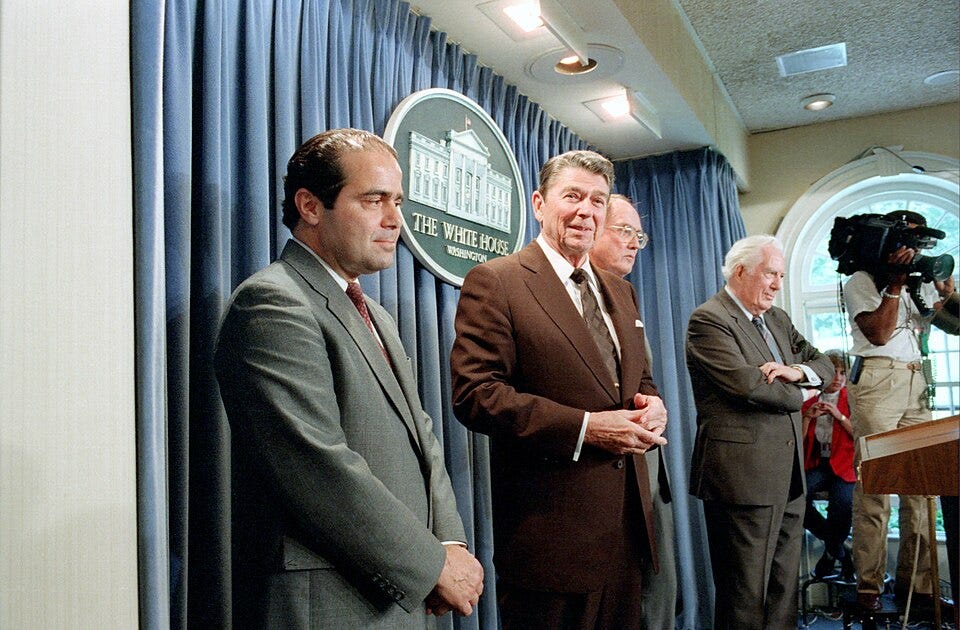
Forty years ago today, the United States Senate confirmed Ronald Reagan’s nomination of Antonin Scalia to the Supreme Court. The Senate vote was 98-0.
I continue here my conversation with federal district judge Patrick J. Schiltz. (See “An Early Look at Scalia-Ginsburg Friendship” for our first exchange.”) Judge Schiltz was a law clerk to Scalia on the D.C. Circuit when Reagan nominated Scalia to the Supreme Court. Schiltz assisted Scalia throughout the confirmation process and went on to clerk for him during his first term on the Court.
Q. When you were finishing up your D.C. Circuit clerkship with then-Judge Antonin Scalia in the summer of 1986, the Supreme Court had its oldest set of five justices ever. Was there a lot of anticipation among you and your fellow D.C. Circuit law clerks about the prospect of a vacancy?
Yes, for sure. All of the judges on the D.C. Circuit—and all of their law clerks—worked in the same building. This was long before COVID normalized working from home. People came to the office every day, had lunch in the same cafeteria, rode the same elevators, saw each other in the hallways. It was a gossipy place.
The most common subject of gossip was whether a Supreme Court justice would retire—and, if so, whether he would be replaced with Judge Bork or Judge Scalia. I don’t recall a third candidate being discussed. The debate among the conservative clerks was about whether Judge Bork or Judge Scalia should be nominated first.
I was, of course, on Team Scalia. In retrospect, though, it seems clear that, if Judge Bork had been nominated first, both of them would have served on the Supreme Court.
Q. In late May 1986, Chief Justice Burger privately informed President Reagan that he would be retiring. The White House seems to have done an excellent job of preventing leaks. When did you first learn of the vacancy?
I had no clue until the morning of Tuesday, June 17, when Judge Scalia called me into his office, asked me to shut the door, and told me that he was on his way to the White House, where the President would announce that Chief Justice Burger was retiring, Justice Rehnquist would take his place, and Judge Scalia would take Justice Rehnquist’s place. The previous day, I suspected something might be up. Judge Scalia had his door shut much of the day (which was unusual), and he disappeared in the middle of the day (ditto).
After he told me, I mentioned how sad it was that neither of his parents had lived to see this day. His mother had died in December, and his father had died a couple of weeks later. He choked up a little bit and said that he was also sad. We agreed, though, that they must be celebrating in heaven.
Q. Were you aware of the Attorney General’s conference on Saturday, June 14 at which Judge Scalia proposed rechristening original intent as original meaning?
No. Judge Scalia frequently gave speeches and rarely asked for assistance with those speeches from his clerks. I don’t think I even knew of the June 14 conference until I read about it in the book of Justice Scalia’s speeches [Scalia Speaks: Reflections on Law, Faith, and Life Well Lived] that you published.
Q. Did you attend the White House announcement ceremony? Any recollections?
Nope. No clerks.
Q. What do you recall of June 17 after Judge Scalia returned to chambers?
At the end of the day, as was our practice, Judge Scalia and I went for a run around the Washington Mall. I had worked on Capitol Hill for Senator Dave Durenberger (R-Minn.) before going to law school, and one of my jobs had been to cover Justice O’Connor’s confirmation hearings. So I knew a lot about the Senators who served on the Judiciary Committee. I spent much of the run briefing him about those Senators. And during the run – although his nomination was the lead story in the national and local media – not a single person showed any sign of recognizing him.
Q. What about the rest of that week?
I remember that the telephone rang constantly. Judge Scalia got lot of calls from friends, reporters, and Supreme Court justices. Sometimes, after a call from a justice, he would come into the clerks’ office (we all shared one large office) and describe the call.
Two phone calls stick out in my memory. I can recall Judge Scalia describing Justice Brennan’s warm and gracious greeting. That was Justice Brennan; Judge Scalia loved him. And I can recall Judge Scalia saying that Justice Rehnquist had called at Justice Blackmun’s behest because Justice Blackmun had heard that Judge Scalia smoked and he wanted to make sure Judge Scalia knew that smoking was forbidden during Conference. That was Justice Blackmun.
Q. Did you play any role in preparing Judge Scalia for his confirmation hearing?
Yes. I was supposed to clerk with Justice O’Connor after clerking with Judge Scalia, but he asked me to stay to help him prepare for his confirmation hearings and then to clerk for him during his first year on the Supreme Court. He said that, if I agreed, he would call Justice O’Connor and smooth things over with her. I agreed, he called her, and she called me. She couldn’t have been nicer about letting me out of my commitment. She said that she had taken one or more of her law clerks from the Arizona Court of Appeals (I can’t recall how many) with her when she joined the Court, and it meant a lot to her to have people in chambers whom she knew and trusted during her first year in the spotlight.
Q. What, then, did you do over the summer?
My main role was to put together “briefing books” for Judge Scalia to read. These books mostly consisted of summaries of his opinions. I don’t know whether or to what extent he ever read them. I also had to proofread and “cite check” the various documents that he had to submit, such as his responses to the ABA and Senate questionnaires.
I also went to some meetings with him. I believe that the first meeting was at the White House, although it might have been at the Old Executive Office Building. We were in a large conference room. [Nominations sherpa] Tom Korologos ran the meeting and sat at one end of a long table. Judge Scalia sat at the other end. There were a lot of people crammed in the conference room—senior aides, junior aides, aides to aides, interns, whatever.
Tom started the meeting by describing how the White House expected the Rehnquist and Scalia proceedings to unfold. Tom then started asking Judge Scalia questions. One of the first was whether there was anything at all in Judge Scalia’s background that, if it came to light, could embarrass him: arrests, abuse, drug use, infidelity? This was in a room full of 25-year-olds with pens poised over their legal pads. The judge looked at me and rolled his eyes.
Judge Scalia did not find the meeting very helpful.
Q. Did Judge Scalia participate in any murder boards?
I can remember one murder board. I may have forgotten about others; this was 40 years ago.
You have to bear in mind that this was a different era. Judge Bork had not yet been “Borked”; confirmation hearings were still (relatively) civil; and a well-qualified nominee could still hope to be confirmed unanimously (as Judge Scalia was). Also, at this time, the bête noire of the political left was Justice Rehnquist. All of the energy of the political left was devoted to stopping Justice Rehnquist’s confirmation. Judge Scalia flew under the radar.
The one and only issue with which I remember Judge Scalia struggling was how to hold the line on not commenting on prior Supreme Court decisions or issues likely to come before the Court. He went back and forth on that. Finally, [senior DOJ official] Brad Reynolds came to chambers for what was essentially a one-person murder board on one topic. Brad pressed the Judge very hard on Brown v. Board: Was it rightly decided? Was it “settled law”? No, you won’t even say that Brown was correct? Yes, but how then can you reconcile Brown with your views about original meaning? The Judge struggled. Eventually, he decided that he would hold a hard line, which he did.
Q. Did Judge Scalia do meet-and-greets with Senators?
Yes. I did not attend, but he told me about some of them when he returned to chambers. He kind of enjoyed them. There wasn’t a lot of discussion about law. They were mostly just chit-chat, and they gave him a chance to turn on the charm.
For someone who had been in or around government much of his life, Judge Scalia had surprisingly little interest in or knowledge of backroom politics. He relied a lot on his close friend and D.C. Circuit colleague Judge Larry Silberman for advice about how Washington worked.
Q. As the date of his confirmation hearing drew close, did Judge Scalia show any sign of nerves?
Honestly, no. Maybe Maureen Scalia or the Scalia children saw something different at home, but I remember him as being joyful during the two months between his nomination and confirmation hearing. He seemed to have no doubt he was going to be confirmed, he seemed to enjoy the attention, and he definitely was itching to start work at the Supreme Court.
***
I look forward to completing my conversation with Judge Schiltz.