


In a deviation from the usual Confirmation Tales fare, let’s take a look at the remarkable story of how one very fortunate law student ended up clerking for Antonin Scalia four decades ago. The story reveals a lot about how the competition for clerkships has changed. It also sheds light on Scalia’s special friendship with Ruth Bader Ginsburg.
***
Patrick J. Schiltz, chief judge of the U.S. District Court for the District of Minnesota, was a law clerk to D.C. Circuit judge Antonin Scalia when Ronald Reagan nominated Scalia to the Supreme Court in 1986. Just a year out of law school, Schiltz assisted Scalia throughout the confirmation process and went on to clerk for him during his first term on the Court.
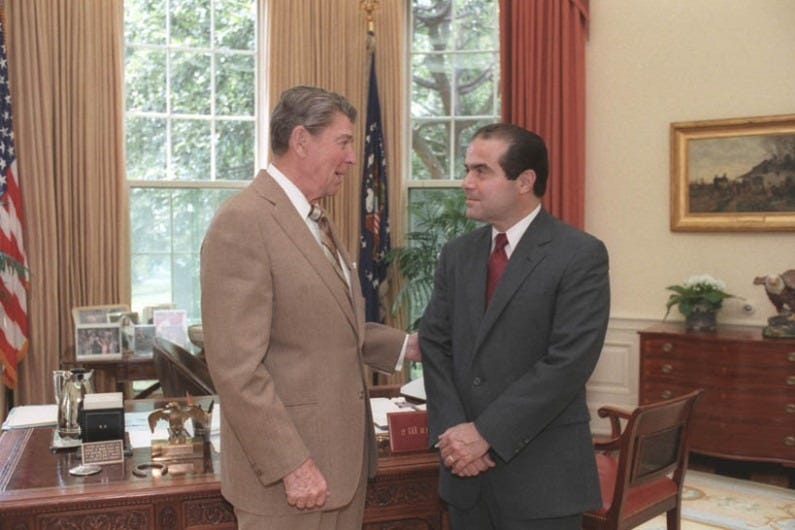
Pat Schiltz and I were friends, classmates, and law-review colleagues at Harvard law school. In organizing the recent AEI-EPPC symposium on Justice Scalia’s extraordinary legacy ten years after his death, I had the opportunity to reconnect with Pat. I was eager to talk with him about Scalia’s confirmation process, and I will draw on his recollections in a later post. But I was especially struck by his story of how he became a law clerk for Scalia.
Q. Antonin Scalia joined the D.C. Circuit in August 1982, weeks before we began law school. Barely a year later, you snagged a clerkship with him for 1985-1986. I’m not sure that I had even heard of Judge Scalia until I learned that you would be clerking for him. How did that come about?
A. The first big step for me was deciding that I should pursue a clerkship. I knew little or nothing about clerking when I started law school. I made the law review on grades at the end of my first year, turned it down because membership would preclude me from participating in the Introduction to Trial Advocacy clinical program (I was certain I wanted to be a trial lawyer), and then was persuaded to accept membership by a few professors and law-review officers. Among the arguments I kept hearing was that being on the law review would help me to get a judicial clerkship, and getting a judicial clerkship would open doors for me. I particularly remember Professor Gary Bellow—who founded HLS’s clinical programs—telling me that, as a law student, I should be opening doors, not closing doors. I’ve been giving the same advice to young lawyers ever since.
Q. How did you become interested in clerking for Judge Scalia specifically?
A. Sometime in the fall of 1983, I decided to start applying for judicial clerkships. I got advice from 3Ls who had been through the process, and they told me that I would need a professor to serve as a reference. I did not know any professors, as almost all of my first-year classes had 140 students, and as I suffered from a severe case of impostor syndrome. Somewhat illogically, I decided to ask Professor Clark Byse—my Administrative Law professor—to be my reference. He was the first-year professor I liked the most, and I figured that, if I liked him, he must have liked me.
I stopped by Professor Byse’s office. He had no idea who I was. He hemmed and hawed and said he didn’t think he could serve as a reference, as he didn’t know anything about me. But we ended up talking for 20 minutes or so, and I later realized that, in between all the hemming and hawing, Professor Byse was interviewing me without my knowing that he was interviewing me. At some point, he brought the conversation to a close and said he’d think about my request.
I walked from Professor Byse’s office to Gannett House—about a three-minute walk. As I climbed the stairs to the second floor (where the law review had its offices), the receptionist told me: “Professor Byse is on hold. He wants to talk to you.” I picked up the phone, said “Hello,” and Professor Byse said: “This is Clark Byse. Judge Scalia will see you tomorrow if you can get to Washington.”
Q. So asking Professor Byse if he would serve as a reference suddenly turned into an interview invitation from Judge Scalia. How did that happen?!?
A. When Judge Scalia was a law student at Harvard in the early 1960s, he had taken Ad Law from Professor Byse, and the two had kept in touch over the years, especially when Judge Scalia worked in the Nixon and Ford administrations. (Judge Scalia chaired the Administrative Conference of the United States for a couple of years in the early 1970s.)
It turned out that, just a couple of days before I stopped by Professor Byse’s office, Judge Scalia had called him. Judge Scalia was not satisfied with the applications he was getting from Harvard, and he wanted Professor Byse to keep an eye out for a student who would be a good clerk and a good match for him. Hence Professor Byse’s non-interview interview of me.
Q. Did you fly to D.C. the next day?
A. No. I called the Scalia chambers, and made an appointment for a couple of days later. I then put together an application and faxed it (we faxed in those days) to the Scalia chambers, as well as to the chambers of some of the other D.C. Circuit judges, explaining that I would be interviewing with Judge Scalia in a couple of days. I quickly got invited to interview with Judge Ruth Bader Ginsburg and with Judge Harry Edwards’s law clerks (he was going to be out of town), but the other chambers said they were not interviewing yet.
Q. What was the Scalia interview like? Did you interview with his law clerks?
A. Interviewing with Judge Scalia then—and during the two years I clerked for him—was nothing like interviewing with him a little later in his career. I did nothing to prepare for the interview, except read over my writing sample. I was not even sure how to pronounce his name. I thought it was pronounced SKAL-ee-ah, but when his judicial assistant referred to him as Judge Sca-LEE-uh, I thought I’d better go with that.
I talked to Judge Scalia first. We talked for about an hour. We talked about law, but mostly we just shot the breeze: about Harvard Law School, about Professor Byse, about politics, about his family, about my family, about our shared Catholic faith. My main memory is how much we laughed. We hit it off.
At the end of the interview, I talked to his law clerks for a few minutes. They pretty much just wanted to know if I had any questions. I was not interrogated. No one asked for my views about the dormant Commerce Clause. No one tore my writing sample to shreds.
I then went back into Judge Scalia’s office, and he said: “I’m not sure what to do. I’d really like you to clerk for me, but I’m afraid if I make you an offer now, you’ll think I’m desperate. So should I make you an offer or not?” We discussed the matter and concluded that, if he wanted me to clerk for him, he would have to offer me a clerkship. So he did.
Q. Did you immediately accept the offer?
A. No. I was going to talk with Judge Ginsburg in a few minutes, and it didn’t seem right to accept an offer from one judge when another had agreed to interview me later that day.
Q. What was the RBG interview like?
A. Nothing like the Scalia interview. When I interviewed with Judge Scalia, he was not wearing a suitcoat, his top button was undone, his tie was askew, his sleeves were rolled up, the top of his desk was a mess, and he was animated. There was, as I said, lots of talk about non-legal matters, and lots of humor.
The top of Judge Ginsburg’s desk was clean, save for my resume, which she had in front of her, and which seemed to be perfectly centered. She sat straight up in her chair during the entire interview, with her hands folded on my resume. She was very nice, but the conversation was formal and almost entirely related to law. After about 20 minutes, she offered me a clerkship, and asked me to get back to her in a day or two. I thanked her and left. I never spoke to her clerks.
Q. So mission accomplished. You had two offers. Time to zip back to Cambridge?
A. No. I then interviewed with the Edwards clerks. They, too, were nice, and they told me that Judge Edwards would be grateful if I would wait until he could interview me before accepting a clerkship offer from another judge. I told them of my offers from Judges Scalia and Ginsburg and that I did not think I could put off a decision. (And although I did not mention this, I could not afford to fly back to Washington. I was dead broke.) They understood.
Q. When did you accept Judge Scalia’s offer?
A. Judge Scalia asked me to stop by his chambers after the other interviews. I told him that I had received an offer from Judge Ginsburg. He spoke highly of her, and told me I could not go wrong choosing between the two offers.
What was most striking, though, was that he asked if there were any other judges for whom I might like to clerk. Idiotically, I told him that the only judge who came to mind was Judge Malcolm Wilkey, who was the leading (really, only) conservative feeder judge on the D.C. Circuit. Rather than being offended, Judge Scalia called Judge Wilkey, told Judge Wilkey that I was sitting in Judge Scalia’s chambers, and encouraged Judge Wilkey to interview me. Imagine one of today’s hyper-competitive appellate judges doing that.
Q. Did you interview with Judge Wilkey?
A. No. In that phone call, Judge Wilkey told Judge Scalia that he was going to retire and therefore he would not be hiring any law clerks. That was the first time Judge Wilkey had told any of his colleagues that he had decided to retire. Judge Scalia seemed startled.
Q. What next?
A. I told Judge Scalia that I wanted to clerk for him. I liked Judge Ginsburg, but I felt a stronger personal connection with Judge Scalia, and he and I were both judicial conservatives. I was worried, though, that accepting Judge Scalia’s offer so soon after talking to Judge Ginsburg would seem insulting.
Judge Scalia told me not to worry. He picked up the phone, called Judge Ginsburg, and said: “Ruth, I’ve got Patrick Schiltz in my office. I told him that he can’t leave until he accepts my offer. He has a plane to catch, so he accepted. Blame me.” I could hear her on the other line telling Judge Scalia that she thought the two of us (that is, Judge Scalia and me) were a great match. She was gracious. Years later, I sat next to her at a dinner for new federal judges. She didn’t remember me, but she was relaxed and candid and funny. Despite our jurisprudential differences, I think I would have enjoyed clerking for her.
Q. It seems that the D.C. Circuit was collegial in 1983.
A. It was remarkably collegial. The judges were smart, they worked hard, they loved the back-and-forth of oral argument and writing opinions, and they got along well. Judge Scalia really missed that when he arrived at the Supreme Court. But that’s a story for another day.
Great story. I got to know both Justices well and observed their close relationship when I put together a judicial exchange with India in 1994. By spending two weeks together with them during that trip I could not miss the obvious mutual respect and friendship.
Great interview, Ed.