


As we have seen, Ronald Reagan didn’t have a lot of obvious candidates to choose from when he set out to nominate the first female Supreme Court justice. It’s still remarkable that Sandra Day O’Connor, as a recently appointed judge on Arizona’s intermediate appellate court, ever received Reagan’s attention. Chief Justice Warren E. Burger deserves the lion’s share of the credit.
***
As Joan Biskupic recounts in her 2005 biography of O’Connor, former Phoenix mayor John Griggs invited O’Connor and her husband on a houseboat trip on Lake Powell in Utah that he and his wife were hosting in August 1979 for Chief Justice Burger and for Griggs’s brother-in-law, who was Burger’s administrative assistant. The O’Connors didn’t know Burger at all, but the Griggses were confident that they would keep the conversation lively. O’Connor made such a favorable impression on the Chief Justice that three months later he invited her to take part in a legal conference—the Anglo-American Legal Exchange—in London in 1980.
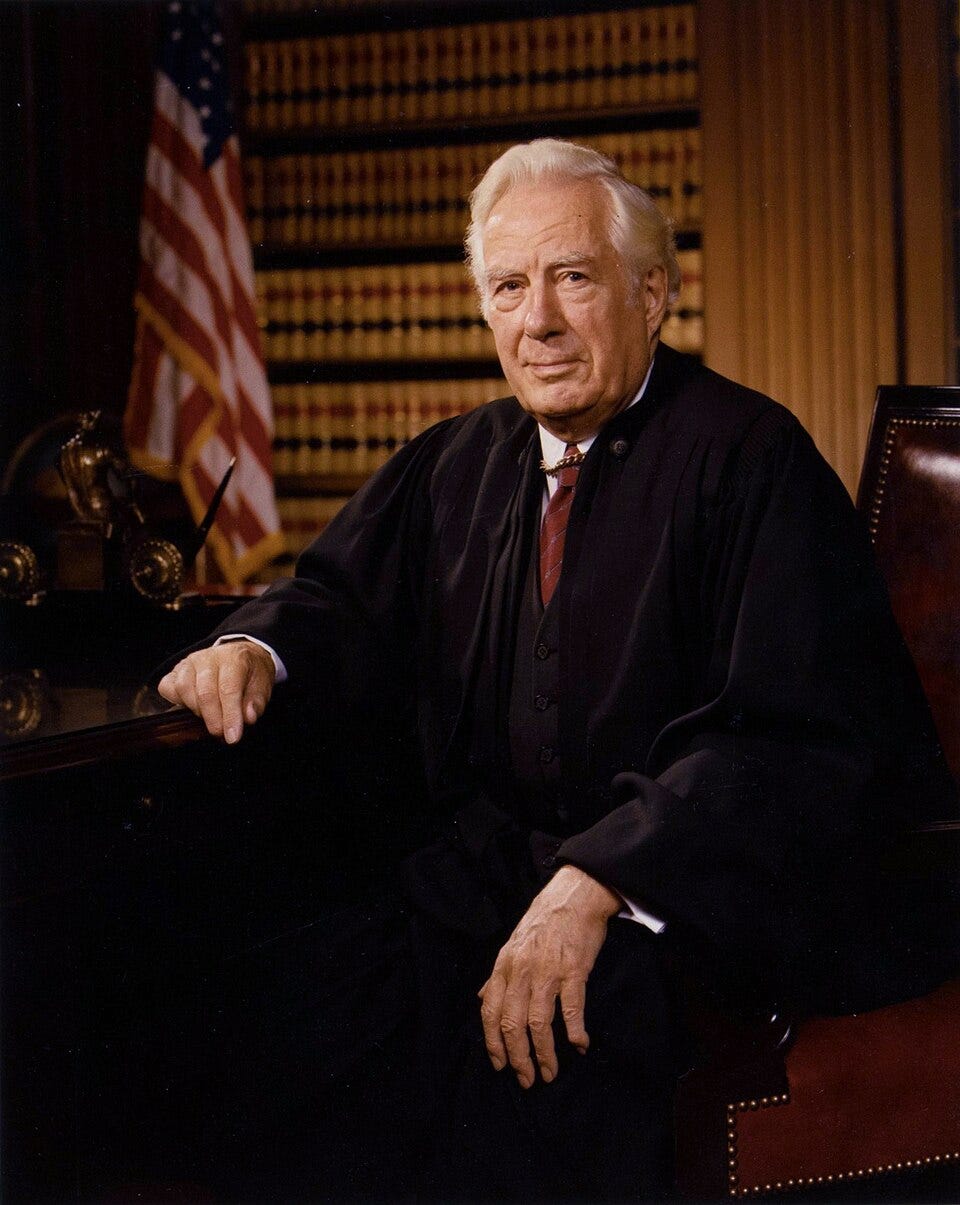
In their three days on the houseboat, O’Connor surely made known to Burger her close friendship with Burger’s younger conservative colleague William H. Rehnquist. O’Connor and Rehnquist had been in the same class at Stanford law school and had dated into their second year. Rehnquist graduated a semester early in December 1951 and moved to Washington, D.C. to clerk for Justice Robert Jackson. Rehnquist’s fondness for O’Connor was so strong that (as Evan Thomas discovered in writing his 2019 biography of O’Connor) he proposed to her by letter in March 1952: “To be specific, Sandy, will you marry me this summer?” Sandra Day, as she was then known, declined, as she was in the middle of an intense courtship with her soon-to-be husband John O’Connor.
Rehnquist married in 1953, and he and his wife became close friends of the O’Connors in Phoenix. When Richard Nixon nominated Rehnquist to the Supreme Court in 1971, O’Connor, then serving in the Arizona senate, hailed Rehnquist as “one of the most brilliant legal minds in the country.” She also launched a remarkably energetic campaign on Rehnquist’s behalf. (I draw here from Biskupic.)
In the realm of very modest speculation, I think it very likely that Burger spoke with Rehnquist about meeting O’Connor and that Rehnquist confirmed Burger’s enthusiasm for her.
***
Even before he was inaugurated as president in 1981, Reagan gave William French Smith, his pick to be Attorney General, a short (and non-exclusive) list of individuals to be considered for a Supreme Court vacancy. Robert A. McConnell, head of the Department of Justice’s Office of Legislative Affairs under Smith, tells me that he understands O’Connor’s name to have been on that list.
There is ample reason to believe that it was Burger who got O’Connor’s name put on that list. As Biskupic recounts, Burger arranged for Reagan to visit the Supreme Court as president-elect, and he “began sending notes [on various topics] to Reagan’s top people.” After Reagan took office, “Burger was quietly putting O’Connor’s name before White House officials.” He invited White House counsel Fred Fielding to his house for lunch. Fielding tells me (in terms similar to what he told Biskupic):
During the luncheon discussion Chief Justice Burger raised the subject of a prospective vacancy. He mentioned having met a most interesting state court jurist on a houseboat trip, Sandra O’Connor, and having been with her at a legal conference in London. It was obvious to me he was trying to plant her name in my mind.
***
I will turn next to how O’Connor managed to win Reagan’s nomination.