


When Ronald Reagan nominated Sandra Day O’Connor to the Supreme Court in July 1981, the Reverend Jerry Falwell, the Baptist televangelist who founded the Christian activist organization the Moral Majority, condemned the pick: “Either the president did not have sufficient information about Judge O’Connor’s background in social issues or he chose to ignore that information.”
After a Rose Garden ceremony at the White House with President Reagan, O’Connor went to meet with members of the Senate Judiciary Committee. Her first meeting was with Charles Mathias, a liberal Republican from Maryland. When Mathias asked O’Connor how all of the attention she was getting was affecting her, O’Connor puckishly addressed the controversy with Falwell:
Well, my husband John thinks it is very exciting to be sleeping with someone opposed by the Moral Majority.
That story is part of the comprehensive account of the O’Connor confirmation process that Robert A. McConnell has recently shared with friends on his email distribution list. Bob, as assistant attorney general for the Department of Justice’s Office of Legislative Affairs, was intimately involved in the process and accompanied O’Connor to all of her meetings with senators. His reminiscences (which he will work into a book full of interesting stories about his experience in the Reagan administration) have inspired me to do a few posts on the O’Connor confirmation. (I thank him in particular for authorizing me to retell the exchange with Senator Mathias.)
***
Sandra Day O’Connor was in most respects a highly improbable candidate for the Supreme Court in 1981.
If you look at the twenty or so justices who were appointed over the previous four decades, you’ll see federal appellate judges, senators and governors, senior Department of Justice officials, prominent lawyers, presidential allies, and a state supreme court justice.
O’Connor had none of these distinctions. She had served on Arizona’s court of appeals—the state intermediate appellate court—for barely a year and as a state trial judge for five years before that. She had been a state senator for five years and had also worked for a few years in the state attorney general’s office. These are all respectable positions, of course, but nothing that would remotely flag her as a Supreme Court candidate. No state judge on an intermediate appellate court had ever been directly appointed to the Supreme Court.
Insofar as considerations of geographic diversity continued to have any weight, it didn’t help O’Connor. Arizona, which then ranked only 29th in population among the states, already had one justice on the Court: William H. Rehnquist, a transplant from Wisconsin, practiced law in Phoenix from 1953 until he joined the Nixon administration in 1969 as assistant attorney general for the Office of Legal Counsel in the Department of Justice.
But unlike the 100 or so previous Supreme Court justices, O’Connor was a woman. That feature, along with her Republican ties, would prove to be a massive advantage.
***
The presidential campaign of 1980 was a three-way race. Republican candidate Ronald Reagan was attempting to defeat Jimmy Carter’s bid for re-election, but he also had to worry about losing voters to John B. Anderson, the longtime Republican congressman who was running as an independent. The Reagan campaign’s internal polls showed that he was in a strong position but that he had a glaring “gender gap”—much weaker support among women than among men.
On October 14—three weeks before the presidential election—Reagan sought to narrow that gap. At a press conference, he declared that it was “time for a woman to sit among our highest jurists,” and he pledged that “one of the first Supreme Court vacancies in my administration will be filled by the most qualified woman I can possibly find.”
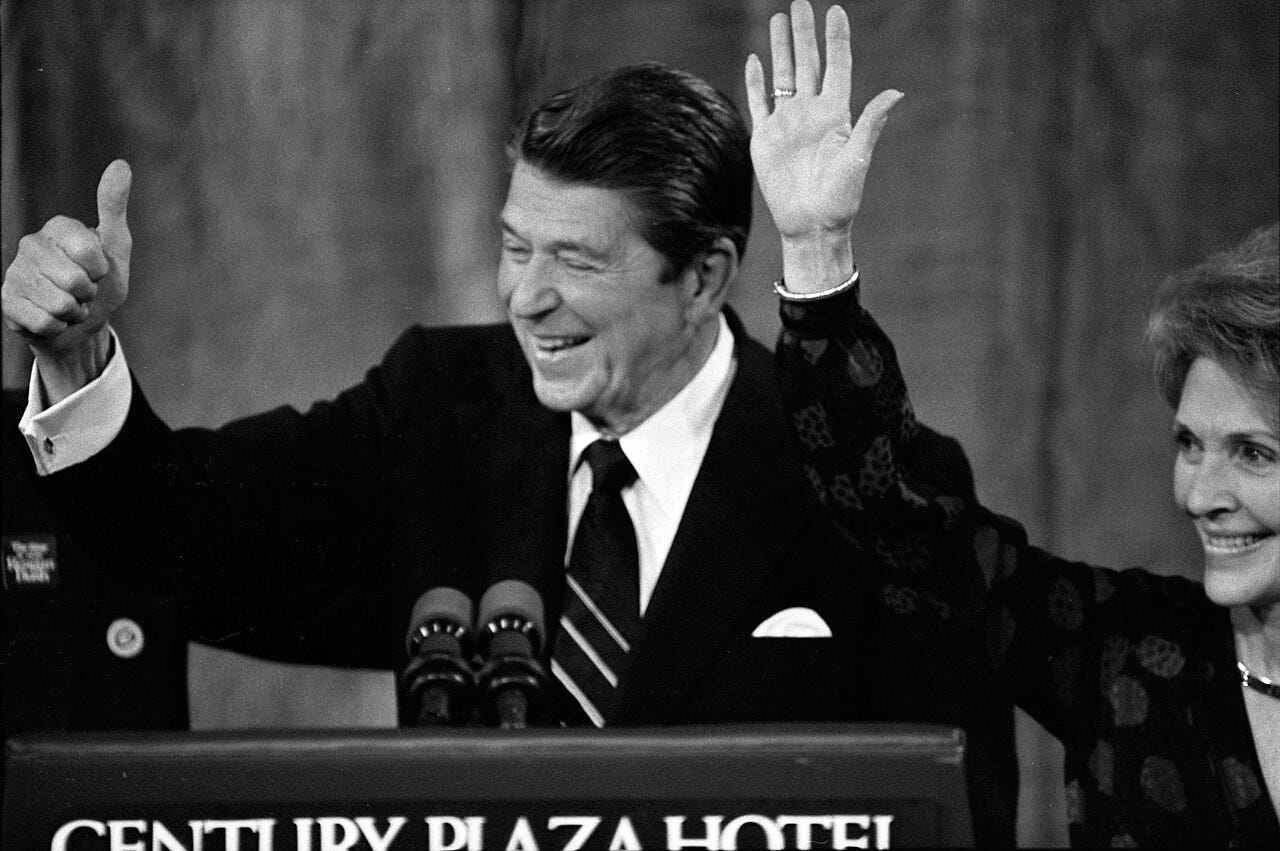
On Election Day, Reagan won in a landslide. He received 489 electoral votes to Carter’s 49 (and Anderson’s zero), and he bested Carter in the popular vote by a margin of nearly 10 points. In an even bigger surprise, Republicans flipped twelve seats in the Senate to win control of that body for the first time since 1955.
In the spring of 1981, Justice Potter Stewart, whom Dwight Eisenhower had appointed to the Court in 1958, informed the White House that he would be retiring.
***
The tremendous strides that women have made in the legal profession over the past several decades can make it easy to forget how different things were in 1981.
Consider the federal appellate courts, which have long been a reliable source of Supreme Court candidates. Florence Allen became the first woman to serve on a federal court of appeals when FDR appointed her to the Sixth Circuit in 1936. It would be more than thirty years before LBJ made Shirley Hufstedler the second by putting her on the Ninth Circuit in 1968.
When Reagan became president, the eleven sitting federal appellate judges who were female had all been appointed over the past two years by Carter. Most of them were very liberal. Only Sixth Circuit judge Cornelia Kennedy invited careful consideration from the Reagan administration. Richard Nixon had appointed Kennedy to a federal district court in 1970. When Carter nominated her to the Sixth Circuit in 1979, liberal groups opposed her as too conservative, and Senator Ted Kennedy, chairman of the Senate Judiciary Committee, was one of four Democrats on the committee to vote against reporting her nomination to the Senate floor.
The federal district courts also weren’t promising. Because the work of a district judge involves much less writing and little or no collaboration with other judges, it’s much more difficult to gauge whether a district judge would make a quality Supreme Court justice. That helps explain why Edward Terry Sanford in 1923 was the last federal district judge to be elevated directly to the Supreme Court. In any event, only six women had been appointed to the federal district courts before Carter became president, and the only one besides Kennedy who had been appointed by a Republican president was Mary Anne Richey, appointed by Gerald Ford in 1976. Richey was already 63 when Reagan was inaugurated.
What about state supreme courts? Here too, Florence Allen was a pioneer, as she became the first woman to serve on a state supreme court when she joined the Ohio supreme court in 1923. It was another 36 years before Rhoda Lewis became the second (Hawaii in 1959). There were 17 more female state supreme court justices over the next two decades. But if there is a conservative or even a moderate somewhere among the likes of Shirley Abrahamson (Wisconsin in 1976), Rose Bird (California in 1977), or Jean Dubofsky (Colorado in 1979), I’m not seeing her.
***
The most prominent conservative female lawyer in 1981 was surely Phyllis Schlafly, leader of the successful campaign to defeat ratification of the Equal Rights Amendment. But her career was as a political activist. She went to law school in her mid-50s and had been a licensed lawyer for less than three years when Stewart retired. Whether she had practiced law much at all in those years is unclear, but no one would have regarded her as a suitable candidate.
***
In sum, if Reagan was looking for a Republican or conservative woman to put on the Supreme Court, there weren’t a lot of candidates. We’ll turn next to the serendipities that explain how he ended up selecting Sandra Day O’Connor.