


Supreme Court justice Potter Stewart invited Attorney General William French Smith to his home on Thursday, March 26, 1981. Stewart informed Smith that he intended to retire from the Court in July. Stewart asked Smith to keep the decision confidential, and Smith assured him that he would tell only President Reagan.
Curiously, Smith did not race to inform Reagan of Stewart’s decision. It’s not clear why not. Smith could immediately have reached Reagan by phone. If he wanted to pass along the news in person, Reagan was at the White House that day, Friday, and through the weekend. But Smith didn’t try to reach him.
On Saturday, Reagan and Smith both went to the Capital Hilton Hotel to attend the Gridiron Club Dinner, noted for its satirical skits. One gag poked fun at Smith’s reputation for saying nothing. Reagan joked that “sometimes our right hand doesn’t know what our far-right hand is doing.”
On Monday, Reagan was at another Hilton, the Washington Hilton, when John Hinckley Jr. severely wounded him in an assassination attempt. In Smith’s judgment, it was “not practical to advise him of the impending vacancy until after he had returned from the hospital.” Reagan was released from the hospital on April 11. But it wasn’t until April 21—26 days after his meeting with Stewart—that Smith informed Reagan that Stewart would be retiring.
***
“I know it when I see it.” That was Supreme Court justice Potter Stewart’s unintentionally suggestive admission of his inability to define obscenity (in his one-paragraph concurring opinion in Jacobellis v. Ohio (1964)). When he publicly announced his retirement in mid-June 1981, Stewart lamented having written the line and joked that it would end up on his tombstone.
Potter Stewart grew up in a prominent Republican family in Cincinnati. His father was the city’s mayor for nine years and a justice of the Ohio supreme court for a dozen years. Stewart received his college and law-school degrees from Yale, where he was a member of the elite Skull and Bones society. Dwight Eisenhower appointed him to the Sixth Circuit in 1954, when he was 39, and to the Supreme Court four years later, when he was 43. (I rely here on Wikipedia.)
Stewart was often in dissent during the Warren Court years, including in the 1965 case of Griswold v. Connecticut, which declared that laws against contraception violated a constitutional right of privacy for married couples. As Stewart put it, “I can find no such general right of privacy in the Bill of Rights, in any other part of the Constitution, or in any case ever before decided by this Court.”
Stewart became more of a centrist on the Burger Court, in part because the Court shifted modestly rightward, in part because he moved leftward. He joined the majority opinion in Roe v. Wade (1973) that asserted a constitutional right to abortion, but he dissented from the Court’s approval of racial preferences in university admissions in Regents of University of California v. Bakke (1978).
Stewart was only 66 when he decided to retire in 1981. He would die four years later.
***
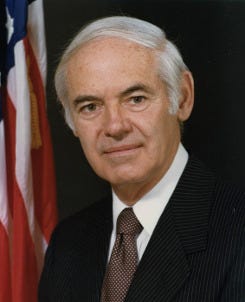
I’ve drawn the account of Stewart’s meeting with Smith from a 12-page memorandum titled “History of the Nomination of Justice Sandra Day O’Connor” that Smith drafted in late September 1981, right after O’Connor joined the Court. Smith, referring to himself in the third person (as “the Attorney General”), explains what he did when he returned to the Justice Department on Friday:
The next day, March 27, the Attorney General directed Kenneth W. Starr, Counselor to the Attorney General, to see that research began into prospective candidates for a Supreme Court appointment in the event that a vacancy should develop. With respect to possible women candidates, he furnished a number of names on a handwritten list to Mr. Starr. Whenever the name of a possible woman candidate had come to the Attorney General’s attention, he had noted it on a telephone message slip which he kept on his desk. The list included Judge Sandra O’Connor, who was identified as an Arizona appellate court judge. The list did not contain Judge O’Connor’s full name.
So unknown was O’Connor that, as Smith goes on to explain, Starr had to return to him to ask “for the full name of the Arizona appellate judge, since the Attorney General’s staff was unable to identify her based upon the information set forth on the handwritten note.” Joan Biskupic, in her biography of O’Connor, tells the story slightly differently but to the same effect:
“Who’s O’Connor?” asked the assistant, Ken Starr, when Smith handed him the slip. “All you’ve got here is a last name.”
Smith’s account is remarkable in at least one other respect. I would have thought that the Attorney General would have made it a high priority to launch a Supreme Court candidate search from his first day in office (which was January 23, 1981), especially since he would have known that it would be challenging to find an outstanding female candidate. Instead, it seems that he was just writing names on a piece of paper.
Smith was very fortunate that Stewart gave him nearly three months of advance notice of his retirement. During that time (as Smith recounts in his memo), Ken Starr was able to organize a team that conducted a back-and-forth process with the Attorney General. The team compiled background information on twenty-one candidates and reviewed their judicial opinions. In mid-May, Starr and his colleague Hank Habicht gave Smith a preliminary report, and the process “intensified” after Stewart publicly announced his retirement on June 18. As we shall see in a later post, the process had one severe defect. I wonder how much worse it would have been if it had been initiated only upon Stewart’s public announcement.
***
Whether or not Smith was aware of it, there was a team of lawyers in the Department of Justice who on their own initiative had been preparing from Day 1 for the possibility of a vacancy. As Bruce Fein, who was Associate Deputy Attorney General, tells me, he established a working group that included Starr, John Roberts, Chuck Cooper, and Carolyn Kuhl. The group created a Top 10 list of judicial conservatives and quickly settled on Robert Bork and Antonin Scalia in the top two spots.
But when Stewart publicly announced his retirement, word quickly came from the White House that his replacement had to be a woman. Reagan’s campaign promise that “one of the first Supreme Court vacancies” during his presidency would be filled by a woman had hardened into this one has to be a woman. The political team in the White House was already preparing for the re-election fight in 1984, and the same “gender gap” concerns that motivated the campaign promise would drive the selection of Stewart’s replacement.