


As legal disputes emerge, they often become matters of inquiry at Supreme Court confirmation hearings. In the early 2000s, controversy erupted over the increasing reliance by various justices on foreign and international law in interpreting provisions of the Constitution.
In late April 2009, just three days before Justice David Souter announced his retirement, Sonia Sotomayor gave a terribly muddled speech in which she defended resort to foreign and international law to decide legal issues generally. That speech ensured that the topic would be prominent in her battle for confirmation.
***
Justice Anthony Kennedy’s majority opinion in Roper v. Simmons (2005) and Justice Antonin Scalia’s dissent helpfully frame the dispute over use of foreign and international legal materials.
Writing for a five-justice majority, Kennedy ruled that the Eighth Amendment’s bar on “cruel and unusual punishments” prohibits the execution of a brutal murderer who was 17 years old at the time of his crime. In Part IV of his opinion, Kennedy found “respected and significant confirmation” for his conclusion that the Constitution bars the death penalty for juvenile offenders “in the stark reality that the United States is the only country in the world that continues to give official sanction to the juvenile death penalty.” Notably, Kennedy invoked Article 37 of the United Nations Convention on the Rights of the Child, which “contains an express prohibition on capital punishment for crimes committed by juveniles under 18.” Kennedy thought that the fact that the United States, alone with Somalia in the world, had not ratified Article 37 supported his conclusion that the death penalty for juvenile offenders is unconstitutional. Kennedy concluded his discussion with this declaration:
It does not lessen our fidelity to the Constitution or our pride in its origins to acknowledge that the express affirmation of certain fundamental rights by other nations and peoples simply underscores the centrality of those same rights within our own heritage of freedom.
Scalia in his dissent confronted head-on the remarkable “confirm[ing] role that Kennedy awarded the “world community” in his determination that the Eighth Amendment forbids the death penalty for juvenile offenders:
“Though the views of our own citizens are essentially irrelevant to the Court’s decision today, the views of other countries and the so-called international community take center stage.”
As for Kennedy’s reliance on Article 37 of the U. N. Convention on the Rights of the Child: “Unless the Court has added to its arsenal the power to join and ratify treaties on behalf of the United States, I cannot see how this evidence favors, rather than refutes, its position.”
“More fundamentally, … the basic premise of the Court’s argument—that American law should conform to the laws of the rest of the world—ought to be rejected out of hand. In fact the Court itself does not believe it.” Scalia proceeded to point out that the Court has never sought to follow foreign law on matters ranging from the exclusionary rule to church-state relations to abortion. “To invoke alien law when it agrees with one’s own thinking, and ignore it otherwise, is not reasoned decisionmaking, but sophistry.”
With respect to Kennedy’s closing oration: “I do not believe that approval by ‘other nations and peoples’ should buttress our commitment to American principles any more than (what should logically follow) disapproval by ‘other nations and peoples’ should weaken that commitment. More importantly, however, the Court’s statement flatly misdescribes what is going on here. Foreign sources are cited today, not to underscore our ‘fidelity’ to the Constitution, our ‘pride in its origins,’ and ‘our own [American] heritage.’ To the contrary, they are cited to set aside the centuries-old American practice—a practice still engaged in by a large majority of the relevant States—of letting a jury of 12 citizens decide whether, in the particular case, youth should be the basis for withholding the death penalty.” (Emphasis and brackets in original.)
***
Justice Ruth Bader Ginsburg and Justice Stephen Breyer, who both joined Kennedy’s opinion in Roper, also spoke out publicly to defend the use of foreign law in interpreting constitutional provisions generally. As it happens, I was criticizing their views in my testimony in the House of Representatives in July 2005 when I learned that George W. Bush would announce that evening that he would nominate John Roberts to the Supreme Court.
The role of foreign and international law in constitutional interpretation played only a small role in Roberts’s confirmation hearing and in Samuel Alito’s hearing some months later. Republican senators condemned the position that Justice Kennedy and his liberal colleagues had adopted. But Democratic senators had no interest in defending it, much less in pressing Roberts and Alito to embrace it.
In response to questioning from a Republican senator, Roberts observed:
In foreign law you can find anything you want. If you don’t find it in the decisions of France or Italy, it’s in the decisions of Somalia or Japan or Indonesia or wherever. As somebody said in another context, looking at foreign law for support is like looking out over a crowd and picking out your friends. You can find them, they’re there. And that actually expands the discretion of the judge. It allows the judge to incorporate his or her own personal preferences, cloak them with the authority of precedent because they’re finding precedent in foreign law, and use that to determine the meaning of the Constitution.
Alito was even more emphatic:
I don’t think that foreign law is helpful in interpreting the Constitution. Our Constitution does two basic things. It sets out the structure of our Government and it protects fundamental rights. The structure of our Government is unique to our country, and so I don’t think that looking to decisions of supreme courts of other countries or constitutional courts in other countries is very helpful in deciding questions relating to the structure of our Government.
As for the protection of individual rights, I think that we should look to our own Constitution and our own precedents. Our country has been the leader in protecting individual rights. If you look at what the world looked like at the time of the adoption of the Bill of Rights, there were not many that protected human—in fact, I don’t think there were any that protected human rights the way our Bill of Rights did.
We have our own law, we have our own traditions, we have our own precedents, and we should look to that in interpreting our Constitution.
***
Now let’s take a look at the speech (see video and my AI-assisted transcript) that Sonia Sotomayor delivered to the American Civil Liberties Union of Puerto Rico on April 28, 2009. The speech is rife with confusion and camouflage, but Sotomayor’s ardent support for looking to foreign and international law to help determine the meaning of constitutional provisions is unmistakable in the end.
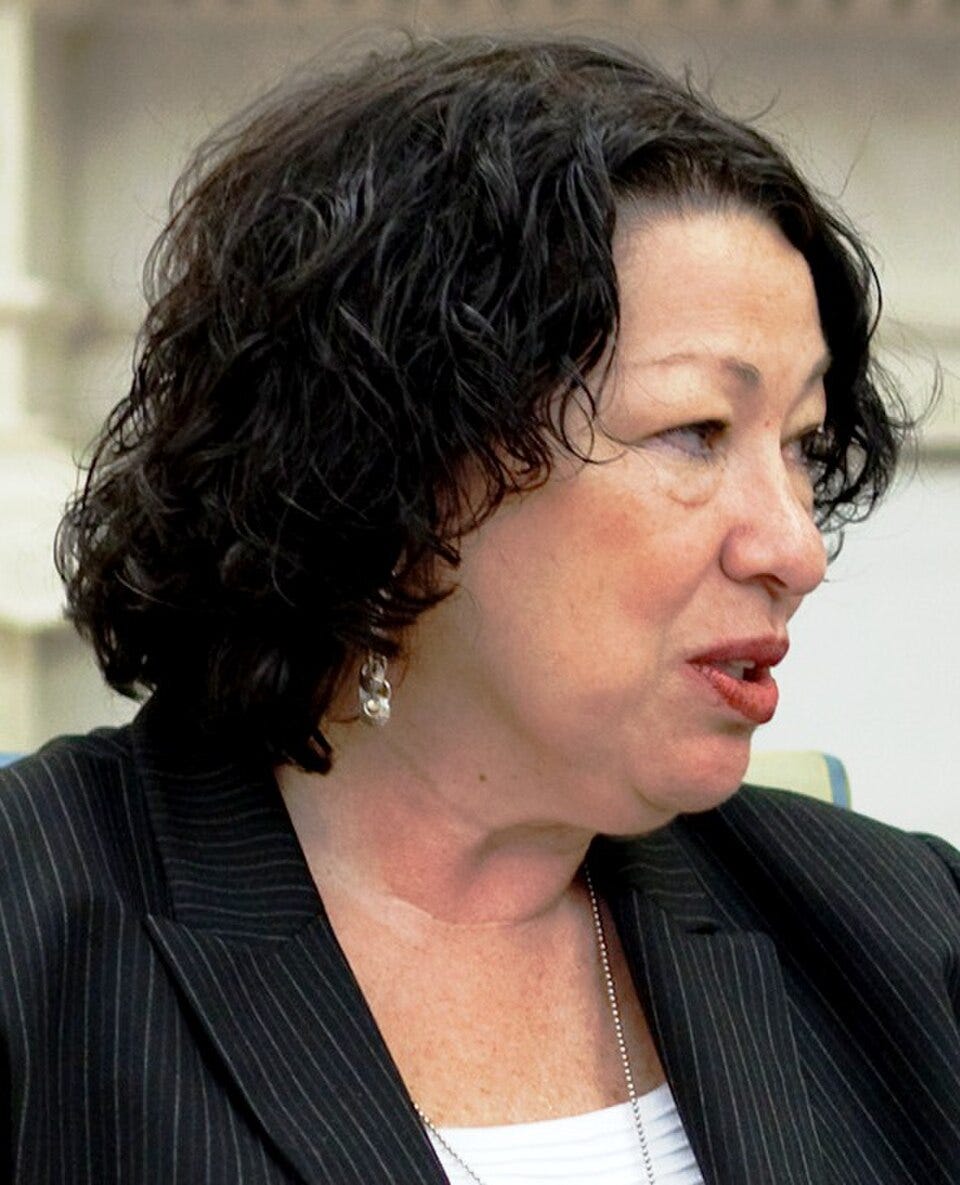
Sotomayor began by positing an unintelligible, but supposedly fundamental, distinction between “us[ing]” foreign and international law and “consider[ing] the ideas that are suggested by” foreign and international law:
I always find it strange when people ask me, “How do American courts use foreign and international law in making their decision?” I pause and say: We don’t use foreign or international law, we consider the ideas that are suggested by international and foreign law. That’s a very different concept.
She repeated this distinction when she explained “the way that American law is structured against the use of foreign and international law”:
Because American analytical principles do not permit us to use that law to decide our cases. But nothing in the American legal system stops us from considering the ideas that that law can give us.
I can make no sense of this distinction. And it was apparently evident to her that her audience couldn’t either, as she asked her translator “do you want to try to translate what I just said?” (It’s conceivable that Sotomayor meant to try to distinguish between treating foreign law as authoritative and looking to it for whatever insights it provides. But if that’s what she meant, her inability to express that simple contrast is astonishing. And no intelligent critic of the Court’s use of foreign and international law thought that the Court was treating it as authoritative.)
In the last third of her talk, Sotomayor embraced the position of Kennedy and Ginsburg against that of Scalia. She missed the core ground of Scalia’s opposition—i.e., that the practice is fundamentally illegitimate because it rests on the unsound premise that American law should conform to the laws of the rest of the world—and instead credited him with a “somewhat valid point” in his secondary objection that “a judge can look to the law of any country to support his or her own conclusion because they'll find somebody to approve or agree with them.” But, she declared,
I share more the ideas of Justice Ginsburg in thinking or in believing that unless American courts are more open to discussing the ideas raised by foreign cases, by international cases, that we are going to lose influence in the world.
Ginsburg is right, she said, that foreign opinions, while “not authoritative,” “can add to the store of knowledge relevant to the solution of a question.” Citing Kennedy’s majority opinions in Roper and in Lawrence v. Texas (2003), Sotomayor approvingly observed: “We have looked in some Supreme Court decisions to foreign law to help us decide our issues.” She then repeated her nonsensical distinction:
In both those cases, the courts were very, very careful to note that they weren't using that law to decide the American question. They were just using that law to help us understand what the concepts meant to other countries and to help us understand whether our understanding of our own constitutional rights fell into the mainstream of human thinking.
Sotomayor ended her speech by insisting that freedom of speech means that American judges have a duty to consider international and foreign law in deciding cases:
To the extent that we as a country remain committed to the concept that we have freedom of speech, we must have freedom of ideas. And to the extent that we have freedom of ideas, international law and foreign law will be very important in the discussion of how to think about the unsettled issues in our own legal system…. [W]ithin the American legal system, we’re commanded to interpret our law in the best way we can. And that means looking to what other, anyone has said to see if it has persuasive value.
***
If you find Sotomayor’s views head-spinning, just wait until you encounter her confirmation testimony.
Not so bad, actuall. A US court can't USE foreign law-- it is no authority, no precedent-- but it can consider the ideas. That's mild. The SUpreme Court can consider Eric Rasmusen's ideas too. But usually it isn't worth it.
Wow! I'm defending the stupidest justice!