


Every judge cares about his seniority—his rank, or precedence, among the judges on his court.
For federal appellate panels, the judge in active service with the highest seniority presides over oral argument, leads the post-argument conference in which the judges decide how they will vote, and (when in the majority) assigns opinions. Seniority also affects who is next in line to become chief judge. And it’s the tiebreaker for various other matters.
Some months ago, I invited readers to pass along their own confirmation tales. Chip Cowell, a retired attorney from Houston who clerked for Judge Betty Binns Fletcher early in her tenure on the Ninth Circuit, passed along one story that highlighted special efforts to ensure that Judge Fletcher had seniority over a colleague, Jerome Farris, whose nomination was confirmed by the Senate on the same day as hers.
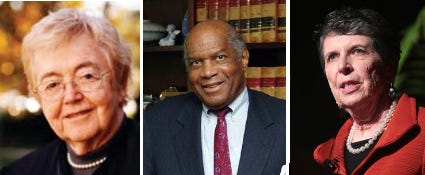
Ironically, in exploring this matter, I discovered that Fletcher may have been inattentive to her seniority relative to a colleague, Mary Schroeder, who received her judicial commission the same day Fletcher did. Under the law, Fletcher should have been senior to Schroeder. But the Ninth Circuit instead accorded Schroeder seniority over Fletcher. And I seem to be the first person to have noticed the decades-long error.
***
The Omnibus Judgeship Act of 1978, signed into law by President Jimmy Carter in October 1978, created 35 new federal appellate judgeships (as well as 117 new federal district judgeships)—a 36% increase in the number of federal appellate judgeships. Its impact on the Ninth Circuit was especially dramatic. It increased the number of seats on that court from 13 to 23—a whopping 77% increase.
Carter acted swiftly to fill the new seats, and he had a clear path. Senator Ted Kennedy, the new chairman of the Judiciary Committee, was eager to help Carter achieve his goal of appointing liberal judges who satisfied sex/race/ethnicity diversity criteria. And Democrats had a huge majority in the Senate.
In 1979 alone, Carter appointed nine judges to the Ninth Circuit. Carter nominated Betty Fletcher and Jerome Farris to Ninth Circuit seats in the state of Washington on the same day in July 1979. The Senate confirmed their nominations on the same day, September 26, 1979.
As Cowell recounts the story, the two Democratic senators from Washington, Warren Magnuson and Henry (“Scoop”) Jackson, championed Fletcher, who was prominent in Seattle legal circles: she was the first woman partner at a major law firm in the city and was the first female president of the county bar association. Although Farris was a state court judge in Seattle, they did not know him well. As Farris recounts in an oral history, he had been referred to Carter by a mutual friend in the Georgia legislature.
Magnuson and Jackson were savvy. They were determined to ensure that Fletcher had seniority over Farris, so they arranged for Carter to issue his judicial commission to Fletcher on September 26 and to wait until the next day, September 27, to issue Farris’s commission.
When judges on the same court occupy the same courthouse, seniority has consequences. As Cowell told me:
This meant that in Seattle Judge Fletcher was always senior to Judge Farris. This resulted in Judge Fletcher occupying one of two graciously appointed judicial chambers on the ninth floor of the federal courthouse in Seattle, with views out across the Seattle downtown and Seattle’s gorgeous harbor. So while Fletcher had chambers on the same floor as veteran Ninth Circuit judge Eugene Wright, Judge Farris was provided with chambers on a much lower floor, at least until Judge Wright took senior status in 1983.
The one day of seniority also meant (as I came to understand it) that from the date Judge Wright took senior status until Judge Fletcher herself took senior status in 1998, Judge Fletcher was the de facto decision-maker for many Seattle courthouse matters. I definitely recall hearing the scuttlebutt that Judge Farris was understandably less than pleased with the misfortune of being beaten out by a day.
***
One day before it confirmed the nominations of Fletcher and Farris, the Senate confirmed two other Ninth Circuit nominees, Otto Skopil and Mary Schroeder. President Carter issued judicial commissions to Skopil and Schroeder on September 26, 1979—the same day as his commission to Fletcher.
You might think that Skopil and Schroeder would have seniority over Fletcher by virtue of having been confirmed a day earlier. That’s evidently what Ninth Circuit chief judge James Browning and his court administrators assumed. But federal law—namely, subsection 45(b) of Title 28—stated (and in its current version still essentially states):
The chief judge shall have precedence and preside at any session of the court which he attends. Other circuit judges shall have precedence and preside according to the seniority of their commissions. Judges whose commissions bear the same date shall have precedence according to seniority in age.
(The second sentence of this subsection was amended in 1982 to clarify that it is addressing seniority among judges of the court “in regular active service.”)
Under subsection 45(b), then as now, the date on which the Senate confirms a nominee is irrelevant to seniority. What matters is the date of their commissions. And when judges have commissions that bear the same date, seniority among them is determined by age.
Skopil was born in 1919. Fletcher was born in 1923. Schroeder was born in 1940. So the order of seniority among the three should have been Skopil, then Fletcher, then Schroeder.
The Ninth Circuit instead treated Schroeder as senior to Fletcher for the entire period—more than 19 years—in which they were both in active service. According to my trusty research assistant (who used AI), over those 19 years there are some 350 decisions, published (such as this one) and unpublished, in which Schroeder presided over a panel that included Fletcher. There are no decisions in which Fletcher presided over a panel that included Schroeder.
***
A proper understanding of subsection 45(b) puts a slightly different spin on the Washington senators’ effort to ensure that Fletcher had priority over Farris. Farris was born in 1930, so even if Carter had commissioned Fletcher and Farris on the same day, Fletcher would have had seniority over Farris.
Perhaps the Washington senators were no more familiar with subsection 45(b) than the Ninth Circuit chief judge was. Or perhaps they didn’t know that Fletcher was older than Farris. Or perhaps they just wanted to make sure that Farris somehow didn’t get commissioned a day earlier than Fletcher did.
In any event, Judge Fletcher got her beautiful chambers but she somehow ended up being denied her seniority over Judge Schroeder.