


Supreme Court appointments, good or bad, reverberate across the decades—not only in the Court’s decisions but also in the timing of the vacancies that arise when justices leave office. Barack Obama has George H.W. Bush and, indeed, Dwight D. Eisenhower to thank for the vacancy that Justice David H. Souter’s decision to retire presented him in 2009.
* * *
In the eyes of conservatives, David Souter was the biggest mistake of George H.W. Bush’s presidency.
In July 1990, after enduring a stroke, Justice William J. Brennan Jr. made the surprising announcement that he was retiring after more than three decades on the Court. Brennan had been a dominant liberal force throughout his tenure. His retirement gave Bush the opportunity to flip Brennan’s seat and to strengthen the budding conservative cohort on the Court.
As Jan Crawford recounts in her excellent book Supreme Conflict: The Inside Story of the Struggle for Control of the United States Supreme Court, Bush somehow ended up nominating Souter, whom he had just months before appointed to the U.S. Court of Appeals for the First Circuit. Souter had served for seven years on New Hampshire’s supreme court, but there was nothing in his record to mark him as a judicial conservative. The fact that his leading advocate was Warren Rudman, the liberal Republican senator from New Hampshire, should have set off alarm bells. Yet Bush’s recommenders (people I like and respect and whose gaffe should thus be a cautionary tale about how very good people can mess up) managed to persuade themselves that he was a stealth conservative. They pushed Souter past his chief contender, the then 41-year-old Fifth Circuit conservative stalwart Edith Jones.
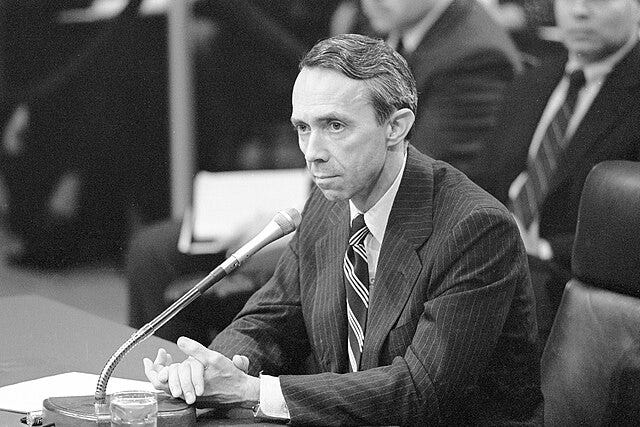
Conservatives grimaced during Souter’s confirmation hearing. Souter testified that “I believe that the due process clause of the 14th amendment does recognize and does protect an unenumerated right of privacy.” He effused praise for Brennan: “Justice Brennan is going to be remembered as one of the most fearlessly principled guardians of the American Constitution that it has ever had and ever will have.” And he displayed a judicial approach that was difficult to distinguish from Brennan’s.
* * *
The White House could in theory have abandoned Souter’s nomination, even after the Senate confirmed it by a vote of 90 to 9 (with Teddy Kennedy and some other liberal Democrats voting against). But the short-term political imperative of every White House is to notch a victory, no matter how illusory that victory is.
* * *
Souter proved to be as bad as conservatives feared. In only his second term on the Court, he co-authored with Justice Sandra Day O’Connor and Justice Anthony Kennedy the joint opinion in Planned Parenthood v. Casey (1992) that refused to overturn the egregious ruling in Roe v. Wade (1973) and restore abortion policy to the democratic processes. The opinion instead espoused a stunningly grandiose vision of the Court’s role—as Justice Antonin Scalia put it in dissent, a “Nietzschean vision of us unelected, life-tenured judges leading a Volk who will be ‘tested by following,’ and whose very ‘belief in themselves’ is mystically bound up in their ‘understanding’ of a Court that ‘speak[s] before all others for their constitutional ideals.’”
At the announcement session, the three justices divvied up the opinion, and Souter presented its stare decisis analysis. It is difficult not to discern his pen in passages like these:
“Where, in the performance of its judicial duties, the Court decides a case in such a way as to resolve the sort of intensely divisive controversy reflected in Roe and those rare, comparable cases, its decision has a dimension that the resolution of the normal case does not carry. It is the dimension present whenever the Court’s interpretation of the Constitution calls the contending sides of a national controversy to end their national division by accepting a common mandate rooted in the Constitution.”
“To all those who will be so tested by following [the Court], the Court implicitly undertakes to remain steadfast, lest in the end a price be paid for nothing. The promise of constancy, once given, binds its maker for as long as the power to stand by the decision survives and the understanding of the issue has not changed so fundamentally as to render the commitment obsolete.”
“Like the character of an individual, the legitimacy of the Court must be earned over time. So, indeed, must be the character of a Nation of people who aspire to live according to the rule of law. Their belief in themselves as such a people is not readily separable from their understanding of the Court invested with the authority to decide their constitutional cases and speak before all others for their constitutional ideals. If the Court’s legitimacy should be undermined, then, so would the country be in its very ability to see itself through its constitutional ideals. The Court’s concern with legitimacy is not for the sake of the Court but for the sake of the Nation to which it is responsible.”
Souter moved decisively leftwards after Casey. After Ruth Bader Ginsburg and Stephen Breyer joined the Court in 1993 and 1994, respectively, he and Justice John Paul Stevens joined with them in forming a liberal bloc that vied for the decisive votes of either O’Connor or Kennedy.
* * *
Souter had a curious mix of qualities and quirks. He was deeply intelligent and learned but wrote turgid and byzantine prose. Legal journalist Jeffrey Rosen described him as “an unapologetically 18th-century character.” One of his law clerks marveled that he “does not use a computer or even a typewriter.” He was amusingly frugal: His standard lunch was a cup of yogurt and an apple; he would eat the entire apple, including its core. When a clerk gave him some Christmas cookies in a plastic sandwich bag, he returned the bag to her along with his note of thanks.
The bachelor Souter lived a very solitary life, but he was also friendly. The year that I clerked for Justice Scalia—the year of Casey—he would routinely greet me by name and make small talk. (His chambers was next to Scalia’s.) When the draft joint opinion in Casey was circulated around the Court, I was appalled. That very morning, we happened to pass in the corridor, and he greeted me with “Good morning, Ed. How are you?” I decided to seize the opportunity: “Well, Justice, since you ask ….” I (perhaps imprudently) proceeded to tell him why I thought that the draft opinion was an abomination, and he graciously listened to me for a few minutes.
Souter was admirably modest as a person. He had no interest in the D.C. power scene, and intensely disliked life in the city long before he was mugged in 2004. He returned to his native New Hampshire each summer as quickly as he could.
Scalia very much liked Souter and even set him up on a blind date. “I miss David,” he mused to me some years after Souter retired.
* * *
Souter developed a strong friendship with Justice Brennan, who in his retirement had his chambers on the second floor of the Court. Souter would visit Brennan often, and Brennan’s legendary charm might well have cemented Souter’s loyalty to his jurisprudence.
In his eulogy at Brennan’s funeral, Souter described himself as part of Brennan’s “huge family by adoption” and observed that Brennan always made him feel as if he were his “favorite child”: “I always felt great when I’d been with Bill.”
Eisenhower is said to have described his appointments of Brennan and of Chief Justice Earl Warren as his “two biggest mistakes.” Brennan in turn inspired the judicial outlook of George H.W. Bush’s biggest mistake.
* * *
David Souter satisfied the Rule of 80 for judicial retirement in May 2005. (He was 65, and, including his short stint on the First Circuit, he had racked up 15 years of judicial service.) He could have chosen then to return to his beloved New Hampshire to hike its mountains, read history and enjoy the quiet life. But had he done so, George W. Bush, the son of the president who appointed him, would have been able to appoint his successor.
Once Obama became president, Souter didn’t delay. On May 1, 2009, he officially announced his retirement. At age 69, he was 19 years younger than John Paul Stevens, and he had served 15 fewer terms on the Court than Stevens had. But now that he had confidence that his successor wouldn’t be a conservative, he raced ahead of Stevens for the exit door.
And so it is that the Supreme Court’s “Seat 3” has been filled by a liberal justice from Eisenhower’s appointment of Brennan in 1956 through today.
A fun tidbit I came across when going through some of the Stevens Papers at the Library of Congress was that Souter was initially an undecided vote at the Conference in United States v. Alfonso D. Lopez, Jr., 514 U.S. 549 (1995). I could send you some of my saved files on this if you'd like.
I also came across a 1987 New York Times article which mentioned that some Reagan Administration lawyers were inclined towards Souter over Kennedy because they figured Souter would be a more reliable conservative. [From the piece: One conservative Republican senator said today that conservatives were raising objections to Judge Kennedy, of the Ninth Circuit, who is seen by many as the leading contender. ''There's concern that Kennedy is not solid enough on issues that conservatives care about,'' this senator said."] Whoops
https://www.nytimes.com/1987/10/29/us/a-new-contender-is-seen-for-court.html
Toobin's book the Nine (yes, Toobin, I know) also notes that O'Connor was on a mission at points to get Souter married, just as Scalia had set up Souter on a blind date.
If Brennan flipped Souter just as he flipped Blackmun, that'd be quite something.
...
Upsides for Souter were his taking the view that Employment Division v. Smith was wrongly decided, his authoring the opinion in Twombly, respect for rights of victims of crimes, his joining decisions limiting the ability of States to impose punitive damages for out of state conduct (which originalists such as Scalia or Thomas may dislike, but the principle that states cannot regulate or punish out of state conduct has gotten broad approval from the Conservative and Originalist Justices subsequently), and some other matters addressed in this Heritage report. It's also notable that he seemed to embrace the Independent State Legislature Theory in Bush v. Gore.
https://www.heritage.org/courts/report/not-zero-sum-game-replacing-justice-souter-risks-more-activist-court
He was certainly better for Conservatives than Brennan or Sotomayor, though obviously Jones not getting the seat was a very big loss for conservatives.